文献精读|为中国而设的计算机:技术贸易与东亚冷战的转型,1968—1980
Journal of Global History
NOVEMBER 2025|VOLUME 20|ISSUE 3
《全球史期刊》
2025年11月|第20卷|第3期
为中国而设的计算机:技术贸易与东亚冷战的转型,1968—1980
Computers for China: Technology Trade and the Transformation of the Cold War in East Asia, 1968-80
BINGYI GONG
引言
INTRODUCTION
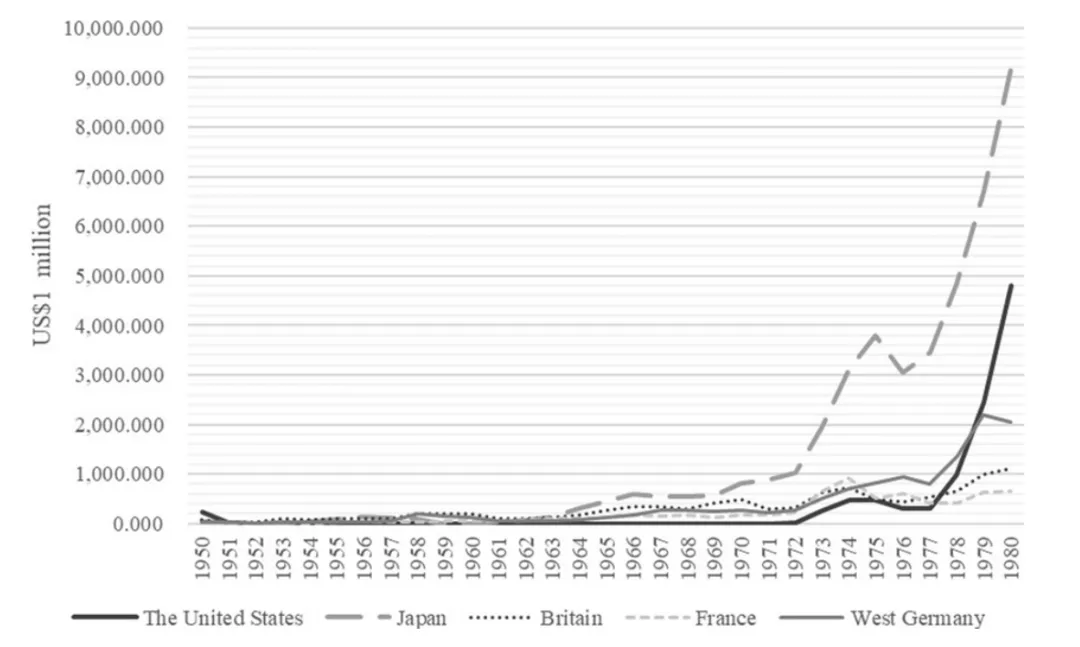
(图 1) 1950—80年中国与主要资本主义国家之间的贸易额(Graph 1) Trade Volume between China and Major Capitalist Countries, 1950-80
1974年7月19日,日本报纸Yomiuri Shimbun刊登了一篇题为《面向中国的计算机:西欧领先,日本追赶》的商业报道。文中写道:“包括美国国际商用机器公司和日本富士通在内的世界各地计算机制造商,都急于同中国开展贸易。”20世纪70年代初,随着中国新近向资本主义阵营开放,并在全球贸易中成为一个令人垂涎的市场,此类场景愈发常见。1971年4月14日,美国总统理查德·尼克松解除了对中国的全面禁运,并允许美国出口非战略商品,作为其推动中美和解努力的一部分;这一努力最终以其于1972年2月访华而达到高潮。不久之后,美国及其盟友,包括法国、英国、西德和日本,都争相向中国出售几乎一切商品,其中包括计算机——据Yomiuri Shinbum所称,这是资本主义阵营禁运清单上的“最后堡垒”。如图1所示,20世纪70年代中国与资本主义国家之间的贸易额激增,凸显出中国有能力将自身从全球贸易中的边缘参与者重新定位为东亚贸易与生产网络中的核心行为者。
On 19 July 1974, the Japanese newspaper Yomiuri Shimbun ran a business report titled ‘Computers for China: Western Europe Leads, Japan Chases’. It read: ‘Computer manufacturers worldwide, including International Business Machines (IBM) in the United States and Fujitsu in Japan, were eager to trade with China’. Scenes like this became increasingly common as China, newly open to the capitalist bloc, emerged as a coveted market in global trade in the early 1970s. On 14 April 1971, US President Richard Nixon lifted the total embargo on China and permitted US exports of non-strategic goods as part of his efforts for the US-China rapprochement, which would culminate in his visit to China in February 1972. Soon enough, the United States and its allies, including France, Britain, West Germany, and Japan, were racing to sell the Chinese almost everything, including computers—the ‘last fort’ of the capitalist bloc’s embargo list, according to Yomiuri Shinbum. As Graph 1 suggests, the trade volume between China and capitalist countries skyrocketed in the 1970s, highlighting the potential of China to reposition itself from a peripheral participant in global trade to a central player in East Asia’s trade and production networks.
本文考察中国与资本主义国家之间围绕技术贸易展开的多边谈判,如何推动了东亚冷战经济分裂的消解。中国——这一具有重大地缘政治意义的共产主义国家——融入全球资本主义,标志着一个分水岭。现有关于这一主题的研究,往往聚焦于20世纪60年代中期西欧国家和日本争取进入中国市场的努力,或聚焦于20世纪70年代初美国通过贸易实现中美和解的战略。学者们主要从双边视角审视中国与资本主义阵营的贸易,而没有将其置于资本主义阵营内部更广泛的动态之中加以语境化。具体而言,他们尚未处理资本主义阵营内部促成放宽对华出口管制的多边谈判,而这一过程是由经济利益与地缘政治利益之间的微妙平衡所驱动的。本文通过强调资本主义国家在放宽对华出口管制和推进对华技术贸易方面的竞争与合作,填补了这一空白,从而展示了在东亚冷战转型之际,中国市场在全球贸易中日益增长的重要性。
This article examines how multilateral negotiations for technology trade between China and capitalist countries helped dissolve the Cold War economic divide in East Asia. The integration of China—a communist country with significant geopolitical importance—into global capitalism marked a watershed. The existing scholarship on this topic tends to focus on the efforts of Western European countries and Japan to gain access to the China market in the mid-1960s or on US strategies for Sino-US rapprochement through trade in the early 1970s. Scholars have examined Sino-capitalist bloc trade primarily through bilateral lenses, without contextualising it in broader dynamics within the capitalist bloc. Specifically, they have not addressed the multilateral negotiations within the capitalist bloc that led to the relaxation of export controls on China—a process driven by a delicate balance between economic and geopolitical interests. This article fills that gap by underscoring the competition and cooperation among capitalist countries in relaxing export controls on and advancing technology trade with China, thereby illustrating the growing significance of the China market in global trade amid the transformation of the Cold War in East Asia.
本文尤其强调多边出口管制统筹委员会在冷战时期中国与资本主义阵营贸易中的重要性。朝鲜战争之后,美国及其盟友通过多边出口管制统筹委员会,对中国施加了甚至比对苏联更为严厉的出口限制——即所谓的“对华差别待遇”。尽管多边出口管制统筹委员会成员在1957年取消了最初的差别待遇,但它们在1969年又引入了一个新版本:通过暂停42项物项对华许可程序、同时简化对苏许可程序,来阻碍中国进行核武器试验。然而,到20世纪60年代末,多边出口管制统筹委员会已成为一个既竞争又合作、颇为特殊的中国市场准入场域。资本主义国家一方面竞相向中国出售商品,包括受限制物项;另一方面又协同减少多边出口管制统筹委员会管制清单上的项目,并批准例外出口,即出于民用目的而对统筹委员会禁运物项实施的一次性出口。尽管学者们研究了多边出口管制统筹委员会在制造经济分裂和限制向共产主义国家转移技术方面的作用,但他们尚未充分探讨其通过放宽出口管制来推进东西方贸易的影响。本文正是通过展示自20世纪60年代末以来,多边出口管制统筹委员会如何演变为资本主义国家之间促进中国与资本主义阵营贸易的谈判平台,来完成这一工作。
This article particularly highlights the significance of the Coordinating Committee for Multilateral Export Controls (COCOM) in Sino-capitalist bloc trade during the Cold War. In the wake of the Korean War, the United States and its allies, through COCOM, imposed export restrictions on China even stricter than those on the Soviet Union—the so-called ‘China differential’. While COCOM members lifted the original differential in 1957, they introduced a new version in 1969, to hinder China from nuclear weapons testing by halting licensing procedures of 42 items toward China, while simplifying those toward the Soviet Union. By the late 1960s, however, COCOM had become a curious venue of both competition and cooperation for access to the China market. Capitalist countries vied to sell goods to China, including restricted items, yet collaborated to reduce items on COCOM control lists and approve exception exports, that was, one-time exports of COCOM-embargoed items for civilian purposes. While scholars have studied COCOM’s role in imposing economic divisions and restricting technology transfer to communist countries, they have not fully explored its influence on advancing East-West trade by relaxing export controls. This article does this by showing how COCOM evolved into a platform for negotiation among capitalist countries to foster Sino-capitalist trade since the late 1960s.
在多边出口管制统筹委员会所管制的数百种物项中,计算机是最关键的物项之一。它是一种典型的军民两用技术:既具有民用用途,也具有军用用途。计算机在第二次世界大战前后被发明并不断改进,它处理海量弹道信息,并在研制原子弹的曼哈顿计划中发挥了关键作用。它也具有广泛的民用用途,从加快机电和电信行业的产品研发,到为肿瘤治疗处理数据。包括国际商用机器公司在内的美国企业在计算机产业中居于领先地位。然而,20世纪70年代,富士通和日立等日本企业通过推出与国际商用机器公司同样精密的大型机,挑战了其在全球市场上的主导地位。那些在政府支持下大举投资计算机开发的西欧企业亦然。与此同时,中国方面热切地从国外寻求先进计算机,将其视为现代化的关键技术,应用领域包括天气预报、铁路设计和石油勘探。
Among hundreds of items controlled by COCOM, the computer was one of the most critical. It was a typical dual-use technology: one that had both civilian and military purposes. Invented and improved before and after World War II, the computer processed vast ballistic information and played a key role in the Manhattan Project to develop the atomic bomb. It also had a wide range of civilian uses, from accelerating product research in electromechanics, and telecommunication industries, to processing data for tumour treatment. US companies including IBM took the lead in the computer industry. However, Japanese companies like Fujitsu and Hitachi challenged IBM’s dominant position in the global market in the 1970s, by promoting mainframe computers that were as sophisticated as IBM’s. So did Western European companies which heavily invested in computer development with governmental support. The Chinese, meanwhile, eagerly sought sophisticated computers from abroad, viewing them as key to modernisation with applications in weather forecasting, railway design, and oil exploration.
1958年,当多边出口管制统筹委员会开始对向共产主义国家出售计算机实施管制时,计算机便成为冷战动态的核心。正如历史学家马里奥·丹尼尔斯所指出的那样,美国政府发展出一种“特殊的、异常繁复的国际机制”,即便在缓和时期也用以限制向苏联出口计算机。历史学家们已经考察了计算机在冷战政治中的作用,重点关注美国与共产主义国家围绕计算机贸易产生的紧张关系,但其在促进中国融入全球资本主义方面的作用仍然探讨不足。计算机兼具军事和民用用途的军民两用属性,使其贸易尤其复杂。日本和西欧国家热切希望将先进计算机用于民用目的出口到中国,但美国却担心这些系统可能会增强中国的军事实力。只有当多边出口管制统筹委员会成员能够集体确保这些出口不会构成安全风险时,出口许可才会获准。正如本文所示,资本主义国家随着时间推移形成了对中国的共同安全认知,并合作保障计算机出口。
Computers became central to Cold War dynamics in 1958 when COCOM imposed controls on computer sales to communist countries. As historian Mario Daniels noted, the US government developed a ‘special, unusually elaborate international regime’ to restrict computer exports to the Soviet Union despite détente. Historians have examined the computer’s role in Cold War politics, focusing on tensions between the United States and communist countries over computer trade, but its role in facilitating China’s integration into global capitalism remains underexplored. The dual-use nature of computers, with both military and civilian applications, made trading them especially complex. Japan and Western European countries were eager to export advanced computers to China for civilian purposes, and yet the United States worried that these systems might bolster China’s military. Export licenses were granted only when COCOM members could collectively ensure that these exports posed no security risks. Capitalist countries, as shown in this article, formed a shared security perception of China in time and cooperated to safeguard computer exports.
本文利用日本、美国、中国和英国的档案来源,以及部分法国材料,考察了1968年至1980年间中国与资本主义阵营之间的计算机贸易个案。1968年是多边出口管制统筹委员会大幅修订出口管制的一年,1980年则是苏联入侵阿富汗后的次年。本文主张,资本主义阵营内部的竞争与合作侵蚀了朝鲜战争之前建立起来的对华限制性贸易体制。尽管资本主义国家在经济利益和安全利益上存在分歧,它们仍通过多边对话在向中国出售技术问题上找到了共同点。因此,中国与资本主义阵营的技术贸易故事,通过揭示军民两用技术作为拆解东西方经济分裂杠杆这一研究不足的作用,丰富了资本主义与技术交流的全球史。此类技术在全球史中往往被视为国际分裂的来源,苏联和中国曾强烈批评资本主义国家对这些技术流动施加的严格限制。然而,本文表明,当多边出口管制统筹委员会能够平衡其成员国的安全利益时,军民两用技术贸易所带来的巨额利润便成为一种强大力量,它推动了新的全球经济与政治互动,扩展了世界贸易体系,并缓和了地缘政治紧张局势。因此,本文通过追踪在既存意识形态和政治分裂之下日益重要的全球性商品的跨区域扩散,复杂化了关于冷战两极格局的历史书写。
Drawing on archival sources in Japan, the United States, China, and Britain, as well as some French materials, this article examines the case of computer trade between China and the capitalist bloc from 1968, when COCOM significantly revised export controls, to 1980, the year after the Soviet invasion of Afghanistan. It argues that the competition and cooperation within the capitalist bloc eroded the restrictive trade regime against China established before the Korean War. Despite capitalist countries’ divergent economic and security interests, they found common ground in selling technology to China through multilateral dialogue. The story of the China-capitalist bloc technology trade thus contributes to global histories of capitalism and technological exchange by illuminating the understudied role of dual-use technology as a lever in dismantling the East-West economic divide. Such technologies often have been viewed in global history as a source of international division, with the Soviet Union and China strongly criticising capitalist countries for their stringent restrictions on the flow of these technologies. This article, however, demonstrates that when COCOM could balance the security interests of its member countries, the enormous profit generated by dual-use technology trade became a powerful force that promoted new global economic and political interactions, expanding the world trade system and easing geopolitical tensions. This article thus complicates histories of Cold War bipolarity by tracing the transregional spread of increasingly important global commodities despite extant ideological and political divides.
叩开中国市场之门
KNOCKING THE DOOR OF THE CHINA MARKET
早在20世纪70年代之前,中国在资本主义国家眼中就已是一个利润丰厚的市场。其中,日本政府在1952年朝鲜战争期间就允许本国公司向中国大陆运送货物,部分是为了振兴战后经济。1958年发生长崎国旗事件,一名右翼青年在一次中国邮票展览上损坏中国国旗,随后中日之间完全中断往来达两年之久;此后,两国政府签署了一系列贸易协定,其中包括1962年的L-T(Liao Chengzhi-Takasaki Tatsunosuke)贸易协定,该协定推动了双边在农产品、矿产等领域的贸易,以及1969年继之而来的MT(备忘录贸易)协定,该协定重申了日中双方在东亚冷战持续闷烧之际维持双边贸易的共识。日本通商产业省鼓励日本企业实现高性能计算机生产本地化并开拓海外市场,将中国视为重要贸易伙伴。1968年10月,日本外务省告诉美国国务院,“加强对华(计算机出口)管制是不可接受的。”然而,在当月的多边出口管制统筹委员会会议上,美国代表团表示反对,声称计算机的设计与工艺具有军事含义,因为它们能够提高核弹头威力和效率以及导弹投送精度。美国代表团断言:“鉴于中国的技术状况,凡属统筹委员会所界定的计算机,均不应出口到中国。”日本与美国围绕对华出口管制的紧张关系正在积聚。
Long before the 1970s, China was already a lucrative market in the eyes of capitalist countries. Among them, the Japanese government permitted its companies to ship goods to the Chinese mainland in 1952, during the Korean War, partially to revitalise its postwar economy. After two years of complete cut-off following the Nagasaki Flag Incident of 1958, in which a rightist youth damaged a Chinese national flag at an exhibition of Chinese stamps, the Japanese and Chinese governments signed a series of trade deals, including the 1962 L-T (Liao Chengzhi-Takasaki Tatsunosuke) trade agreement, which boosted bilateral trade in agricultural products and minerals, among other fields, and the succeeding MT (Memorandum Trade) agreement of 1969, which reconfirmed the agreement between Japan and China on maintaining bilateral trade in the midst of the smouldering Cold War in East Asia. The Ministry of International Trade and Industry of Japan, encouraging Japanese companies to localise the production of high-performance computers and explore overseas markets, viewed China as an important trade partner. In October 1968, the Foreign Ministry of Japan told the US State Department that ‘it was not acceptable to strengthen controls (on computer exports) toward China’. At the COCOM meeting that month, however, the US delegation disagreed, averring that computer designs and processes had military implications since they could improve the yield and efficiency of nuclear warheads and the delivery accuracy of missiles. ‘In view of the state of technology in China’, the US delegation asserted, ‘no computers as defined by the Coordinating Committee should be exported there’. Tensions between Japan and the United States over export controls on China were building.
英国政府同样支持放宽出口管制。1950年1月,英国承认中华人民共和国,以保护其在华商业利益。20世纪50年代和60年代,英国政府与中国政府通过英国直辖殖民地香港维持双边贸易,香港使中国得以通过出口赚取急需的外汇,并进入国际金融市场。在1968年11月的一次多边出口管制统筹委员会会议上,英国代表提出了一项放宽对那些并非用于太空探索或武器研发的计算机出口管制的方案。他援引了计算机在人类活动中的广泛应用——从武器研发到工业制造——以及资本主义国家和共产主义国家对用于地质勘探和人口普查等民用目的计算机日益增长的需求。然而,美国代表再次表示反对。他坚持认为,共产主义国家可能会利用先进计算机进行核武器研发和导弹投送。英国决策者对此感到沮丧,因为他们正在支持英国商界为新兴的计算机产业开拓新市场。20世纪60年代,英国政府通过先进计算机技术项目大举投资高性能计算机,承担了私营部门约50%的研究费用。1969年1月,伦敦官员告诉美国国务院,英国接受对计算机组件技术和生产设备施加更严格的出口限制,但“并没有收紧计算机整机成品限制的打算”。随着技术能力迅速追赶美国,英国热切推动对华计算机出口。
The British government also supported relaxing export controls. In January 1950, it granted recognition to the PRC to protect its commercial interests in China. The British and Chinese governments maintained bilateral trade throughout the 1950s and 1960s through the British crown colony of Hong Kong, which offered the Chinese opportunities to earn much-needed foreign currency through exports and access to international financial markets. At a November 1968 COCOM meeting, the British delegate put forward a proposal to relax export controls on computers that were not intended for space exploration or weapon development. He cited the widespread use of computers in human activities—from weapon development to industrial manufacture—and the increasing demand for computers for civil purposes such as geological prospecting and population census in both capitalist and communist countries. The US delegate took exception again nonetheless. He maintained that communist countries might use sophisticated computers for nuclear weapon development and missile delivery. British policymakers were frustrated as they supported British businesspeople in exploring new markets for the burgeoning computer industry. During the 1960s, the British government invested heavily in high-performance computers through the Advanced Computer Technology Project, covering around 50 per cent of private-sector research expenses. In January 1969, officials in London told the US State Department that it accepted stricter export restrictions on computer component technologies and production equipment but was ‘not in the mood for curtailing of end-items on computer’. Rapidly catching up with the United States in technological capabilities, Britain zealously promoted computer exports to China.
法国政府在其工商界支持下,自20世纪60年代初以来便试图发展对华商业联系。1963年9月,由法国全国雇主委员会远东研究小组主席纪尧姆·乔治-皮科率领的一批法国工业界代表经由香港访问中国,并与中国领导人,包括国务院副总理陈毅和对外贸易部副部长卢绪章,就改善中法经济关系交换意见。随着中法两国政府于1964年1月建立外交关系,双边贸易立即突破1亿美元。1965年12月,法国汽车制造商贝利埃与中国签署了一项重要合同——“中国许可证”——向中国提供1035辆卡车,并转让制造许可以建立工厂。1966年11月,双方又签订了另一项合同,由贝利埃再提供600辆卡车。1969年5月,大约40家法国公司在北京展出了机床和土木工程设备。中方对这些展品表现出浓厚兴趣。该月最后一天,国务院副总理李先念向法方工作人员询问了展览细节,随后又在法国驻北京大使艾蒂安·马纳克陪同下出席了活动。随着中法外交关系正常化,通过一系列商业谈判和展览,双边贸易迅速扩张。
The French government, supported by its business community, sought to foster commercial ties with China since the early 1960s. In September 1963, a group of French industrial representatives led by Guillaume Georges-Picot, president of the French Far East Study Group of the French National Committee of Employers, visited China via Hong Kong and exchanged ideas with Chinese leaders including Vice Prime Minister Chen Yi and Vice Minister of Foreign Trade Lu Xuzhang to improve Sino-French economic relations. As the French and Chinese governments established diplomatic relations in January 1964, bilateral trade immediately surpassed US$100 million. In December 1965, French automotive manufacturer Berliet signed an important contract—‘China License’—with China to supply 1,035 trucks and transfer manufacturing licenses to establish a factory. Another contract followed in November 1966 for Berliet’s provision of another 600 trucks. In May 1969, about forty French companies exhibited machine tools and civil engineering equipment in Beijing. The Chinese showed great interest in these exhibits. On the last day of that month, Vice Premier Li Xianian inquired about the exhibition’s specifics from the French staff and subsequently attended the event accompanied by the French Ambassador to Beijing Etienne Manac’h. Following the normalisation of Sino-French diplomatic relations, bilateral trade expanded rapidly owing to a series of commercial negotiations and exhibitions.
与其盟友不同,美国政府最初只是把贸易当作向中国政府发出的外交信号。1969年12月,尼克松批准美国公司从第三国进口中国商品,包括香港;在那里,中国国有公司,最著名的是华润(Huarun),一直在同资本主义国家进行贸易。1970年4月,尼克松政府授权对中国实行选择性出口许可。三个月后,美国商务部通过海外经销渠道,向中国延伸发放了装配于意大利自卸卡车中的通用汽车发动机以及通用汽车土方设备的出口许可。除了缓和中美紧张关系之外,尼克松放宽对华贸易限制还有第二个动机——安抚其日益因美国限制而不满的盟友,因为这些限制远远超出了多边出口管制统筹委员会的要求。美国国务院在1969年4月报告说,将贸易限制降低到多边出口管制统筹委员会水平,将使美国公司能够“与欧洲和日本利益争夺中国市场”,并“消除当前贸易管制超额部分在对盟友关系中所构成的摩擦源”,尤其是对日本和英国的关系。
Unlike its allies, the US government initially used trade merely as a diplomatic signal to the Chinese government. In December 1969, Nixon approved US companies to import Chinese goods from a third country, including Hong Kong, where Chinese state companies, most notably Chinese Resources (Huarun), had been trading with capitalist countries. In April 1970, the Nixon administration authorised selective export licensing to China. Three months later, the Commerce Department extended licenses for General Motors (GM) engines—incorporated in Italian dump trucks—and GM earthmoving equipment through overseas dealerships to China. In addition to easing US-China tensions, Nixon had a secondary motive to relax trade restrictions on China—to placate its allies, increasingly frustrated with US restrictions, which far exceeded the COCOM requirements. The State Department reported in April 1969 that lowering trade restrictions to the COCOM level would enable US companies to ‘compete with European and Japanese interests for China market’ and ‘eliminate the irritants that the extra aspects of present trade controls represented in relations with allies’, especially Japan and Britain.
对中国而言,相较于其他资本主义国家,美国是一个可以忽略不计的贸易伙伴。在1971年春季广州交易会上,对外贸易部部长李蜀德将西方国家分为三类:1.中国愿积极开展贸易的国家,包括法国、瑞典、芬兰、加拿大、瑞士、意大利、丹麦和挪威;2.中国仅愿适度开展贸易的国家,如英国和奥地利;3.由于政治问题,中国将增加出口但维持适度进口的国家,包括西德、比利时、澳大利亚、新西兰和荷兰。李蜀德指示各地市和省级代表,美国“帝国主义者”是与“苏联修正主义者”同样的敌人,应当“集中一切力量去斗争”。所有参加广州交易会的资本主义商人都热衷于同中国做生意。英国观察员约翰·丹森在交易会上报告说,日本人主导了中国市场,而加拿大人在1970年10月中加建交后热切推进小麦贸易。美国“帝国主义者”则远远落后。1972年4月,大约40名美国商人首次参加广州交易会,与中方签订了70多项合同,但这些交易总值仅为178万美元,不足交易会总成交额的1%。中美贸易被中日贸易所掩盖。直到1978年,它甚至仍小于中国与英国和法国的贸易规模。
For China, the United States was a neglectable trading partner compared to other capitalist countries. At the Spring 1971 Canton Trade Fair, Minister of Foreign Trade Li Shude categorised Western countries into three groups: 1. countries with which China would eagerly trade, including France, Sweden, Finland, Canada, Switzerland, Italy, Denmark, and Norway; 2. countries with which China would trade only to a modest degree, such as Britain and Austria; and 3. countries which, due to political issues, China would increase exports to yet maintain moderate imports from, including West Germany, Belgium, Australia, New Zealand, and the Netherlands. Li instructed municipal and provincial representatives that the American ‘imperialists’ were enemies on par with ‘the Soviet revisionists’, with which they should ‘concentrate all the strength to fight’. All the capitalist businesspeople who attended the Canton Trade Fair were keen on trading with China. John Denson, a British observer at the fair, reported that the Japanese dominated the China market, and the Canadians zealously advanced wheat trade after the establishment of Sino-Canadian diplomatic relations in October 1970. American ‘imperialists’ were falling far behind. In April 1972, some forty US businesspeople participated in the Canton Fair for the first time and signed over seventy contracts with the Chinese, but the total value of these transactions was only US$1.78 million, less than one per cent of the total deals made at the fair. Sino-American trade was overshadowed by Sino-Japanese trade. Until 1978, it even remained smaller than Chinese trade with Britain and France.
尼克松继续放宽对华贸易限制。1971年6月,在解除对华禁运两个月后,他公布了一份包含47类可出口非战略物项的清单,其中包括农产品、家用电器、汽车和钢铁等基础金属。尼克松政府也开始逐案审查那些具有潜在战略价值的主要物项,例如高级计算机、商用飞机、卡车和机车,并在“符合美国国家安全要求”的情况下授予特别许可。这一举动在资本主义阵营内部引起回响。日本政府赞扬美国的决定“有助于缓和远东紧张局势”,而英国政府则立即向美国申请特别许可,以便向中国出口约翰·布朗工程公司的工业燃气轮机发电机组;该设备使用了通用电气公司的技术诀窍和组件。美国商务部承诺加快审查进程,在两周内作出回应,仅为通常所需时间的一半。在美国批准下,这笔交易进展顺利。约翰·布朗工程公司于1971年12月21日与中国机械进出口总公司签署了一份350万英镑的合同,并在8个月后完成交付。由于尼克松的新政策,越来越多来自美国及其盟友的技术涌入中国市场。
Nixon continued to relax trade restrictions on China. In June 1971, two months after lifting the China embargo, he released a list of 47 categories of exportable and nonstrategic items, including farm products, household appliances, automobiles, and basic metals like steel. The Nixon administration also began to review major items of possible strategic value, such as high-grade computers, commercial aircrafts, trucks, and locomotives, on a case-by-case basis and granted special licenses if ‘consistent with the requirements of US national security’. This move reverberated within the capitalist bloc. The Japanese government applauded the US decision as ‘contributing to alleviating the tension in the Far East’, while the British government immediately sought a special licence from the United States to export John Brown Engineering’s industrial gas turbine generating sets to China, which used know-how and components of General Electric (GE). The US Commerce Department promised to expedite the review process and respond within two weeks, half the usual time. The business went smoothly with US approval. John Brown Engineering signed a £3.5-million contract with China National Machinery Import and Export Corporation (CNMIEC) on 21 December 1971 and completed the delivery eight months later. Owing to Nixon’s new policy, a growing number of technologies from the United States and its allies flooded into the China market.
资本主义国家开始在多边出口管制统筹委员会内采取更大胆的行动。1971年12月,日本代表提议废除中国委员会,这是多边出口管制统筹委员会内负责管理《中国特别综合清单》的一个工作组,而该清单早在1958年就已废止。加拿大代表支持日本的提议,认为这是终结1968年“对华差别待遇”的第一步。1972年1月,多边出口管制统筹委员会所有成员都同意废除中国委员会。到1975年3月,多边出口管制统筹委员会已在许可程序上以近似水平对待中国和苏联,它将42项中的41项从管制清单中删除,只剩计算机作为“对华差别待遇”中的唯一一项。
Capitalist countries began to take bolder action in the COCOM. In December 1971, the Japanese delegate proposed to abolish the China Committee (CHINCOM), a working group in COCOM to administer the Consolidate China Special List, which had long been abolished in 1958. The Canadian delegate supported the Japanese proposal as the first step toward ending the 1968 ‘China Differential’. In January 1972, all COCOM members agreed to abolish the CHINCOM. By March 1975, the COCOM were treating China and the Soviet Union at a similar level in the licensing procedure by removing 41 out of 42 items from the control list, leaving the computer as only one item in the ‘China Differential’.
与此同时,中国从资本主义国家进口技术的规模也在扩大。紧随尼克松访华之后,中国政府在1972年春季广州交易会上优先购买美国技术,中国对外贸易部在会上接待了愿意出售先进技术的美国出口商,其中包括旧金山商会和索宾化学公司的代表。然而,当中国开始实施一项有组织地从资本主义国家进口现代技术的计划时,它优先选择那些已经建立正式外交关系的美国盟友作为贸易伙伴。1973年3月,中国国务院启动了“‘四三方案’(Sisan Fang’an)”,计划耗资43亿美元从资本主义国家,特别是日本和西德,进口成套工厂和机器,这是继20世纪50年代中苏经济合作之后的第二个此类项目。各省市当局仿效中央政府的做法。1973年9月,上海市轻工业局实施了13个来自日本和西欧国家的进口项目,涵盖从食品加工到印刷等领域。遵循毛泽东“‘洋为中用’(Yangwei Zhongyong)”的指示,中国政府接纳了来自资本主义阵营的技术。
At the same time, China’s technology imports from capitalist countries were expanding. On the heels of Nixion’s visit, the Chinese government prioritised the purchase of US technology in the Spring 1972 Canton Fair, where the Ministry of Foreign Trade of China hosted US exporters willing to sell advanced technology, including representatives from the San Francisco Chamber of Commerce and Sobin Chemicals Company. As the Chinese embarked on an orchestrated plan to import modern technology from capitalist countries, however, they prioritised US allies with formal diplomatic ties as trading partners. In March 1973, the State Council of China launched the ‘Four-three Plan’ (Sisan Fang’an) to spend US$4.3 billion on importing whole plants and machines from capitalist countries, particularly Japan and West Germany, a second such project after the Sino-Soviet economic cooperation of the 1950s. Provincial and municipal authorities emulated the central government’s behaviour. In September 1973, the Shanghai Municipal Bureau of Light Industry conducted thirteen import projects from Japan and Western European countries, ranging from food processing to printing. Following Mao’s instruction ‘Making the foreign serve China’ (Yangwei Zhongyong), the Chinese government embraced technology from the capitalist bloc.
西欧国家和日本发展出多种在中国推销计算机的策略。例如,一家日本计算机企业向田中角荣首相的秘书提议,在首相于1972年9月访问中国时,把计算机作为礼物带去。田中政府对这一想法很感兴趣,但由于高性能计算机在管制清单之上,而较不复杂的计算机也因“对华差别待遇”而被禁止,这一计划未能获得多边出口管制统筹委员会批准。日本、法国、英国以及其他若干资本主义国家还在1972年和1973年举办了大约10场工业展览,并播放其产品的宣传影片。例如,英国工业技术展览于1973年3月在北京举行,共有349家英国公司参加,涵盖从航空航天仪器到电子产品、从工业装置到科学工具的广泛产品。面对展会上签订的价值逾100万英镑的合同,北京英国大使馆参赞迈克尔·H.摩根称赞其“有力推动了英中之间更长期贸易的发展”。
Western European countries and Japan developed various strategies to market computers in China. A Japanese computer firm, for example, proposed to Prime Minister Tanaka Kakuei’s secretary that the prime minister bring computers as souvenirs when he visited China in September 1972. The Tanaka administration was keen on the idea, but it failed to obtain approval in the COCOM since high-performance computers were on the control list, and even less sophisticated computers were off limits due to the ‘China Differential’. Japan, France, Britain, and several other capitalist countries also held some ten industrial exhibitions in 1972 and 1973, with promotional videos of their products. The British Industrial Technology Exhibition, for instance, took place in Beijing in March 1973, joined by 349 British companies, covering a wide range of products from aerospace instruments to electronics, industrial plants to scientific tools. Marvelling at the contracts signed at the exhibition, worth more than £1 million, Michael H. Morgan, a counsellor at the British Embassy in Beijing, praised it as ‘a powerful boost to the development of longer-term trade between Britain and China’.
西欧国家和日本还通过另一条渠道培育中国市场:科技交流。它们派遣技术人员赴华,向中国官员展示产品样品、样机和工业材料,并就中方在工厂中遇到的具体问题提出建议。1972年秋,来自19家日本公司的43名代表巡访中国,并与来自9个国家部委以及全国179家制造和研究机构的195名中国代表会谈。例如,岛津制作所的技术人员介绍了日本计算机产业在软件设计和硬件制造中的人力资源管理,强调进一步增加对软件开发投资的重要性和必要性。1970年至1973年间,来自日本、西德、英国、法国、意大利和加拿大等国的2234名代表,在中国举行了1746场科技座谈会。中方为这些国家的技术实力所吸引,这似乎使美国的现代技术不再显得不可替代。中国对外贸易部于1973年11月报告说,美国与其他资本主义国家在民用技术上的差距正在缩小——美国盟友在某些领域甚至具有竞争优势,例如西德在冶金、机械、汽车、化工和石油化工产业以及电子领域。对中国而言,在技术贸易上始终存在美国之外的其他可靠伙伴。
Western European countries and Japan cultivated the China market through another channel: science and technology exchanges. They sent technicians to China to showcase product samples, model machines, and industrial materials for Chinese officials while offering suggestions on specific problems that the Chinese were encountering in factories. In the autumn of 1972, 43 representatives from nineteen Japanese companies toured China and talked with 195 Chinese representatives from nine national ministries and commissions as well as 179 manufacturing and research institutions nationwide. Technicians from Shimadzu Corporation, for example, introduced human resource management in software designing and hardware manufacturing in Japan’s computer industry, emphasizing the importance and necessity of more investment in software development. Between 1970 and 1973, 2,234 delegates from countries like Japan, West Germany, Britain, France, Italy, and Canada, held 1,746 symposiums on science and technology in China. The Chinese were mesmerised by the technological prowess of these countries, which seemed to obviate modern US technology. The Ministry of Foreign Trade of China reported in November 1973 that the gap in civilian technology between the United States and other capitalist countries was narrowing—US allies even had competitive edges in certain areas, such as West Germany’s metallurgy, machinery, automobiles, chemical and petrochemical industries, and electronics. The Chinese always had other reliable partners in technology trade than the United States.
在资本主义国家争夺中国市场的竞争中,法国尤为突出。尽管20世纪70年代初的中法贸易规模与中日贸易相比仍然有限,但法国在对华技术出口上十分大胆。它们绕过多边出口管制统筹委员会的出口管制向中国出售军事技术,例如在1972年通过一家瑞士子公司向中国出口了一台用于导弹跟踪的电影经纬仪。法国还通过提升技术能力来取得计算机贸易优势。仅在1973年一年,法国政府在计算机研发上的投入就是英国政府的数倍。英国计算机公司由于与其他资本主义国家的竞争,以及市场需求——既包括大型机也包括小型机——的多样化而疲于应对,它们试图通过开拓中国这样的新海外市场来求生,而不是依赖政府对行业的补贴。对于法国企业而言,突破贸易限制并利用技术优势,是其同中国进行技术贸易的关键。
France stood out in the capitalist competition for the China market. Although Sino-French trade in the early 1970s was in a modest volume compared with Sino-Japanese trade, the French were bold in technology exports to China. They bypassed the COCOM export controls to sell military technology to China, for instance, exporting a cine theodolite for missile tracking through a Swiss subsidiary in 1972. The French also enhanced technological capability to obtain advantages in computer trade. In 1973 alone, the French government invested several times as much in computer research and development as the British government did. British computer companies, exhausted by the competition with other capitalist countries and the diversification of market demands—for both mainframe computers and minicomputers—struggled to survive by cultivating new overseas markets like China, not by relying on government subsidy in the industry. For French companies, overcoming trade restrictions and leveraging technological advantages were crucial in their technology trade with the Chinese.
尽管美国企业拥有先进的技术能力,但由于严格的贸易限制,它们在向中国出口方面步履维艰。1972年3月,美国国务院总结说,多边出口管制统筹委员会中的“对华差别待遇”对美国的伤害大于其盟友,因为“在美国具有技术领先优势的领域——即航空电子设备、通信设备和计算机……技术更先进的美国产品遭到禁运,而较不先进生产者的产品却不受其限”。尽管国防部反对,尼克松仍接受了国务院取消“对华差别待遇”的建议。尼克松政府进一步放宽了对华出口管制,特别是在其相对于盟友拥有技术优势的行业中,包括计算机。1973年7月,尼克松任命国际经济政策委员会成员格斯·W.韦斯二世领导一个跨部门工作组,研究向中国出售计算机的方式,并分析其中涉及的安全风险。根据该工作组的建议,尼克松于1974年3月14日发布第247号国家安全决策备忘录,取消了美国对华与对苏计算机出口限制之间的差别。美国急于在争夺中国市场的竞赛中赶上其盟友。
US companies, despite their advanced technological capabilities, struggled to export to China due to stringent trade restrictions. In March 1972, the US State Department summarised that the ‘China Differential’ in the COCOM harmed the United States more than its allies because ‘in areas where the United States had a technological lead—namely, avionics, communications equipment, and computers . . . the more sophisticated US items are caught by the embargo while the products of less advanced producers are not’. Despite the Defence Department’s resistance, Nixon accepted the State Department’s suggestion of abolishing the ‘China Differential’. The Nixon administration further relaxed export controls on China, particularly in industries where it had a technological advantage over its allies, including the computer. In July 1973, Nixon appointed Gus W. Weiss Jr., a member of the Council on International Economic Policy, to lead an interagency task force to investigate ways to sell computers to China and to analyse the security risks involved. Upon recommendations by the task force, Nixon issued the National Security Decision Memorandum 247 on 14 March 1974, which eliminated the differential of US restrictions on computer exports to China and to the Soviet Union. The United States was anxious to catch up with its allies in the race to the China market.
全球危机之下的机遇
OPPORTUNITIES BENEATH THE GLOBAL CRISIS
20世纪70年代中期,中美和解势头的减退阻碍了双边贸易。美国总统杰拉尔德·福特放弃推进与中国关系正常化,因为国会警告说此举会损害美台关系。中国领导人对关系正常化的热情也有所下降,部分原因在于他们相信即便没有美国援助,也能够对抗苏联。由于坚持在扩大双边贸易之前先实现中美关系正常化,中国领导人转而向那些已与中国实现关系正常化的美国盟友购买先进技术。例如,1973年,国务院副总理李先念与负责中国国务院外贸事务的陈云批准从西德和日本进口1.7米钢板轧机,而拒绝了美国价格更低的报价,原因在于双方尚未建立外交关系。1973年1月15日,对外贸易部部长白相国会见英国首相爱德华·希思时,代表中国政府表达了对蓬勃发展的中英贸易的满意,并强调“现有良好的政治关系基础也是一个积极因素”。中美关系的停滞把商机留给了其他资本主义国家。
In the mid-1970s, the receding momentum of the US-China rapprochement hindered bilateral trade. US President Gerald Ford gave up advancing the normalisation of relations with China as Congress warned that it would damage US-Taiwan relations. Chinese leaders also became less passionate about normalisation, partially because they were confident in confronting the Soviet Union without US assistance. Insisting on normalising US-China relations before expanding bilateral trade, Chinese leaders turned to US allies, with which it had normalised bilateral relations, to purchase advanced technology. For instance, in 1973, Vice Prime Minister Li Xiannian and Chen Yun, who was in charge of foreign trade affairs in the Chinese State Council, approved the import of 1.7-meter steel sheet rolling mills from West Germany and Japan, rejecting a lower-price offer from the United States due to the absence of diplomatic relations. When Minister of Foreign Trade Bai Xiangguo met with Prime Minister Edward Heath on 15 January 1973, he, on behalf of the Chinese government, conveyed his satisfaction at the burgeoning Sino-British trade, highlighting that ‘the existing good base in political relations was also a positive factor’. The stagnation in US-China relations left business chances to other capitalist countries.
英国政府抓住一切机会加强与中国的经济联系。1973年6月,一批来自英国外交及联邦事务部的官员,包括外交及联邦事务大臣亚历克·道格拉斯-霍姆,说服中国外交部长姬鹏飞相信,鉴于英国是欧洲经济共同体成员,而欧洲经济共同体是一个成立于1957年、独立于多边出口管制统筹委员会之外的区域性经济组织,因此英国政府对中国施加的出口管制将很少。中国政府对英国政府致力于双边贸易以及英方所提供的统计数字感到高兴。1973年,中英贸易额激增至6.3216亿美元,较前一年翻了一番。1974年5月,邓小平副总理访问英国时称赞道:“英国比某些其他国家更开明,对贸易采取了不那么严格的态度。”
The British government seized every chance to strengthen economic ties with the Chinese. In June 1973, a group of British officials from the Foreign and Commonwealth Affairs Office including the Secretary of State for Foreign and Commonwealth Affairs Alec Douglas-Home convinced Chinese Foreign Minister Ji Pengfei that the British government would place few export controls on China given that Britain was a member of the European Economic Community (EEC), a regional economic organisation created in 1957 and separate from the COCOM. The Chinese government was delighted at the British government’s commitment to bilateral trade as well as its statistical data. The trade volume between Britain and China surged to US$632.16 million in 1973, marking a twofold increase from the previous year. When Vice Premier Deng Xiaoping visited Britain in May 1974, he praised that ‘Britain was more enlightened than some other countries and took a less strict attitude about trade’.
大约在同一时期,计算机贸易的机会越来越明显地蕴藏在石油工业之中。由于拥有丰富的陆上和海上石油储量,中国对用于石油勘探的先进计算机需求日增。美国早在1957年就已安装了8台大型机和74台中型计算机用于地质数据处理;而到1963年,位于黑龙江省的中国最大油田大庆油田仅有2台模拟计算机,这显然不足以分析东北地区复杂的地质特征。1970年,中国石油化学工业部计划进口用于地震勘探的数字计算机。
Around the same time, it became increasingly clear that opportunities for the computer trade lay in the oil industry. With abundant onshore and offshore oil reserves, China increasingly demanded advanced computers for oil exploration. The United States had installed eight mainframe computers and 74 medium-sized computers for geological data processing as early as 1957; Daqing, the largest Chinese oilfield in Heilongjiang Province, had only two analogue computers by 1963, which proved insufficient to analyse the complex geological features of the Northeast region. In 1970, the Ministry of Petrochemical Industry of China planned to import digital computers for seismic exploration.
1973年石油危机加速了资本主义国家与中国之间围绕石油勘探展开的技术转移。深受石油冲击重创的日本,是最积极向中国提供勘探和开发石油技术的国家之一。日本于1973年购买了少量中国石油,并将目光投向与中国签订长期石油贸易协议。1975年11月,日本通商产业大臣河本敏夫说服中国对外贸易部部长李强,称中国对日石油出口“对双方互利”。在会见中国石油化学工业部部长康世恩时,河本承诺以石油交换中国所需的先进技术和设备。与河本访华同时,伊藤忠商事——日本最大的“综合商社”(sogo shosha)之一,自20世纪60年代初以来被北京视为“友好商社”(youhao shangshe)——的一个代表团抵达北京,参加关于液化天然气的技术座谈会;液化天然气是一种使天然气成为石油可行替代品的最先进技术。此后,他们又前往上海,在上海化学工业局代表陪同下考察当地工业发展。1976年3月,由Yazawa Eimei领导的一个代表团——其人时任日本科学仪器协会会长——巡访了中国各地的研究机构和炼油厂,推销为石油加工设计的日本仪器。日本商界人士和政治家不遗余力地同中国开展“以技术换石油”的交易。
The 1973 oil crisis accelerated technology transfer for oil exploration between capitalist countries and China. Wrecked by the oil shock, Japan was among the most zealous countries to provide technology to explore and develop Chinese oil. Japan purchased a small amount of Chinese oil in 1973 and set its eyes on a long-term oil trade agreement with China. In November 1975, Japanese Minister of International Trade and Industry Koumoto Toshio convinced Chinese Minister of Foreign Trade Li Qiang that China’s oil exports to Japan were ‘mutually beneficial to both sides’. At a meeting with Chinese Minister of Petrochemical Industry Kang Shi’en, Komoto promised to provide advanced technology and equipment for China in exchange for oil. Parallel to Koumoto’s visit, a delegation of Itochu Corporation, one of the largest Japanese ‘general trading companies’ (sogo shosha), treated by Beijing as a ‘friendship trade company’ (youhao shangshe) since the early 1960s, arrived in Beijing to attend technological symposia on liquified natural gas (LNG), state-of-the-art technology that made natural gas a viable substitute for oil, and later visited Shanghai to survey the local industrial development accompanied by representatives from the Shanghai Chemistry Industry Bureau. In March 1976, a delegation led by Yazawa Eimei, president of the Japanese Scientific Instruments Association, toured research institutes and petroleum refineries around China, touting Japanese instruments designed for oil processing. Japanese businesspeople and politicians spared no efforts in trading technology for oil with the Chinese.
英国商界也希望进口中国石油。他们努力向中国转移石油勘探技术,以便把中国石油作为中东石油来源之外一种更具成本效益的替代选择。1975年10月,英国石油公司董事长埃里克·德雷克访问中国石油化学工业部,希望“使英国在中国的版图上成为未来石油技术和设备的来源地”。在中国访问期间,他还参观了北京石油化工厂,以考察中国生产石油相关产品的能力。与日本类似,英国寻求与中国建立以技术换石油的长期合作关系。
The British businesspeople hoped to import Chinese oil as well. They strove to transfer oil exploration technology to China to secure access to Chinese oil as a cost-effective alternative to Middle Eastern sources. In October 1975, Eric Drake, chairman of the board of British Petroleum, visited the Ministry of Petrochemical Industry of China, hoping to ‘put Britain on the Chinese map as a future source of oil technology and equipment’. During his trip to China, he also toured the Peking Petrochemical Plant to investigate China’s capacity for oil-related product manufacturing. Similar to Japan, Britain sought long-term cooperation with China in trading technologies for oil.
1974年,法国和加拿大公司也在竞争向中国出售用于石油勘探的计算机。当年2月,控制数据公司的法国子公司与法国石油公司Compagnie Generale Geophysique联合尝试向中国技术进出口总公司——一家从事对外技术贸易的国有公司——出售一台用于海上石油勘探地震数据处理的赛伯计算机及其相关软件。与此同时,由控制数据公司加拿大方面牵头的一个加拿大集团也与中国技术进出口总公司就同一产品启动了商业谈判。经过6个月谈判,中国技术进出口总公司与法方签订了一份价值670万美元的合同,而与加方的平行谈判则告吹。中国石油生意的诱惑,甚至把同一家计算机公司的姊妹子公司都变成了竞争对手。
French and Canadian companies also competed to sell to the Chinese computers for oil exploration in 1974. That February, CDC France, the French subsidiary of computer giant Control Data Corporation (CDC), and Compagnie Generale Geophysique (CCG), a French oil firm, jointly tried to sell a Cyber computer and associated software designed to process seismic data for offshore oil exploration to the China National Technical Import and Export Corporation (TECHIMPORT), a state-owned company for foreign technology trade. At the same time, a Canadian group led by CDC Canada initiated commercial negotiations with TECHIMPORT for the same product. With six months of negotiations, TECHIMPORT signed a contract valued at US$6.7 million with the French while parallel negotiations with the Canadian broke off. The lure of Chinese oil business turned even sister subsidiaries of the same computer company into rivals.
美国公司并未袖手旁观。它们一再劝说中国对外贸易部和中国国际贸易促进委员会——一个成立于1952年的半官方贸易组织——推进中美在油气勘探方面的技术合作,其中包括据传自然资源丰富的南海。到1976年5月,美国石油公司Geospace已经向中国出口了两台计算机,用于处理石油勘测中的地理数据。此外,Geospace还安排了一支现场设备技术人员队伍,培训中国方面如何操作专为勘探作业设计的特种车辆。然而,正如中央情报局所指出的那样,美国在“以技术换石油”的竞赛中落后于其盟友。到1975年8月,中国燃料化学工业部和中国机械进出口总公司已与来自日本、法国和丹麦的公司签订了海上支援设备合同,并正计划从西德购买钻井设备。相比之下,美国公司进展甚微。
US companies did not just sit by. They repeatedly persuaded the Ministry of Foreign Trade of China and the China Council for the Promotion of International Trade, a semi-governmental trade organisation founded in 1952, to advance US-China technology cooperation in oil and gas exploration, including in the South China Sea, which was rumoured to be rich in natural resources. By May 1976, US oil firm Geospace had exported two computers to China for processing geographical data in oil surveys. In addition, Geospace arranged a team of field equipment technicians to train the Chinese to operate special vehicles designed for exploratory work. As noted by the Central Intelligence Agency, however, the United States fell behind its allies in the race for ‘technology for oil’. By August 1975, the Ministry of Fuel and Chemical Industrial of China and CNMIEC had signed contracts with companies from Japan, France, and Denmark for offshore support equipment, and were planning to purchase drilling equipment from West Germany. On the contrary, US companies made little progress.
美国的出口管制是主要祸首,但福特并不容易修正这一点。福特急于维持与莫斯科的缓和关系,而莫斯科猛烈抨击了限制向苏联提供信贷的进出口银行立法,以及《1974年贸易法》中拒绝给予任何限制移民国家——包括苏联——最惠国待遇的约翰逊—瓦尼克修正案,因此福特坚持实行一视同仁的出口管制政策——即对苏联和中国施加同等限制。1975年2月,美国计算机公司伯勒斯计划向中国机械进出口总公司出售一台B-7700型计算机。伯勒斯声称,B-7700型的性能能力并未超过已售往苏联的计算机。然而,美国国务院仍然反对。同年9月,由商务部长、国务卿和国防部长组成的跨部门委员会——出口管理审查委员会——拒绝了伯勒斯的申请,认为B-7700型过于先进,不宜出口中国。
US export controls were the main culprit, but Ford could not fix them easily. Desperate to maintain détente with Moscow, which railed at the Export-Import Bank Legislation that restricted credits to the Soviet Union and the Johnson-Vanik amendment to the 1974 Trade Act that denied most favoured nation (MFN) status to any country restricting emigration, including the Soviet Union, Ford adhered to an even-handed export control policy—imposing equal restrictions on the Soviet Union and China. In February 1975, US computer firm Burroughs planned to sell CNMIEC a B-7700 computer. The performance capabilities of B-7700, Burroughs claimed, did not exceed those of computers sold to the Soviet Union. The State Department took exception nonetheless. That September, the Export Administration Review Board, an interagency board composed of the Secretaries of Commerce, State, and the Secretary of Defence, rejected Burroughs’ application, viewing B-7700 as too sophisticated for exporting to China.
在拒绝伯勒斯请求之后,美国决策者煞费苦心地向中国领导人解释美国的一视同仁政策。1975年12月,邓小平副总理向福特总统和国务卿亨利·基辛格抱怨美国对中国进口施加的严格限制。基辛格解释说,美国政策不允许向中国或苏联出口每秒计算速度为1000万次运算的计算机。福特补充道:“副总理先生,原则上,我们非常希望在计算机领域提供帮助,我想我们是能够做到的。”基辛格鼓励中方向伯勒斯等美国公司咨询,找出既能满足中国需要,又符合美国政府和多边出口管制统筹委员会批准标准的计算机。换言之,福特政府坚持维持其出口管制。
US policymakers took pains to clarify US even-handed policy to Chinese leaders after the denial of Burroughs’ request. In December 1975, Vice Premier Deng Xiaoping complained to President Ford and Secretary of State Henry Kissinger about the strict restrictions on Chinese imports. Kissinger explained that the US policy did not allow exporting computers with the calculating speed of ten million operations per second to either China or the Soviet Union. ‘Mr. Vice Premier’, Ford added, ‘in principle, we would be very anxious to be helpful in the computer area, and I think we can be’. Kissinger encouraged the Chinese to consult US firms like Burroughs to identify computers that met China’s needs and the standard of approval by the US government and COCOM. The Ford administration, in other words, insisted on maintaining its export controls.
然而,美国的盟友仍在敦促美国作出改变。渴望获得中国石油的法国政府寻求美国合作,以便向中国出口一台用于石油勘探的先进计算机赛伯172型。与B-7700型案件不同,美国政府最初并未否决,而是搁置了赛伯172型的许可申请;该申请由控制数据公司的法国子公司于1975年5月通过其设在美国的母公司提交。B-7700型具有水利工程和冶金等广泛终端用途,因此需要严格的现场保障措施以防潜在军事转用,而这一条件是中方无法接受的。赛伯172型虽然同样先进,但其用途仅限于海上石油勘探中的地震数据处理,因此不需要现场保障措施。由于对向中国出口计算机持谨慎态度,美国国家安全委员会要求中央情报局就中国计算机产业的发展以及美国商务部当时实行的许可政策开展研究。1975年10月,在控制数据公司提交申请5个月后,中央情报局报告说,中国计算机产业严重依赖外国技术,因为其现有国产计算机“仅相当于10年前美国计算机的效能”。中央情报局还指出,中方拒绝实施诸如现场检查之类的保障措施,而这正是美国政府预料之中的。美中两国政府在保障措施问题上的分歧,给中国进口美国计算机带来了挑战。
Nevertheless, US allies pressed the United States to make a change. Thirsty for Chinese oil, the French government sought US cooperation to export Cyber 172, a sophisticated computer for oil exploration, to China. Unlike in the B-7700 case, The US government initially pended, rather than denied, the license application of Cyber 172, which CDC France submitted through its US-based parent company in May 1975. B-7700, with extensive end-uses like hydraulic engineering and metallurgy, required strict on-site safeguards against potential military diversion, a condition unacceptable to the Chinese. Cyber 172, though as sophisticated as B-7700, was limited to seismic data processing in offshore oil exploration. On-site safeguards were unnecessary. Cautious about computer exports to China, the US NSC requested a CIA study on the development of the Chinese computer industry and the licensing policy currently implemented by the Commerce Department. In October 1975, five months after CDC’s application, the CIA reported that the computer industry in China was heavily reliant on foreign technology since current domestic computers were ‘only as effective as US computers of ten years ago’. The CIA also noted that the Chinese refused to implement safeguards, such as on-site inspections, which was anticipated by the US government. Disagreements between the US and Chinese governments on safeguards challenged China’s imports of US computers.
为所有相关方——控制数据公司、美国和中国政府以及多边出口管制统筹委员会成员——找到彼此都能接受的保障措施,是关键所在。中国机械进出口总公司拒绝提供进口计算机的最终用途和使用者信息,但美国官员耐心解释说,无论出口目的地为何,获取这些信息都是国际贸易的常规程序。经过数轮谈判,美国国务院同意放弃其对苏联所要求的“更为严格的程序”,并以中国机械进出口总公司提供的“一封载有大部分——如果不是全部——相关信息的信函”来替代正式的最终用户声明。许可程序仍未完成。1975年9月,法国政府向美国官员施压,要求加速对赛伯172型案件作出决定,但由于对保障措施的担忧,这一请求被拖延。美国政府把法国政府施加的压力转移给了控制数据公司及其法国子公司。1976年3月,美国商务部把美国批准所附带的条件告知控制数据公司,这些条件比其预期更为严苛,其中包括一项条款,即“至少在赛伯172型[在中国]安装并验收后的3年内,将其正式使用限制在地震数据中心”。中国进口方绝不会接受这样的条件。两个月后,控制数据公司为打破僵局,向中国机械进出口总公司提出了一项技术服务协议,安排一名人员驻场18个月,并保留此后继续来访的可能性。中国机械进出口总公司原则上同意了这一方案,但并未授予该技术人员对赛伯172型不受限制的接触权限。
Finding mutually acceptable safeguards for all stakeholders—CDC, the US and Chinese governments, and COCOM members—was the key. CNMIEC declined to provide information on imported computers’ end uses and users, but US officials patiently explained that obtaining this information was a routine procedure of international trade, regardless of export destinations. After several rounds of negotiations, the State Department agreed to forgo ‘more rigorous procedures that [it] required from the USSR’ and to substitute a formal end-user statement with ‘a letter containing most, if not all, of the pertinent information’, provided by CNMIEC. The licensing process was not yet complete. In September 1975, the French government pressured US officials to expedite a decision on the Cyber 172 case, but the request was delayed due to concerns about safeguards. The US government shifted the French government’s pressure to CDC and its French subsidiary. In March 1976, the Commerce Department informed CDC of the conditions for US approval, harsher than the CDC had anticipated, including a clause that ‘limited official use at the seismic data centre for at least three years after installation and acceptance of Cyber 172 [in China]’. The Chinese importer would never accept such a condition. Two months later, CDC proposed a technical service agreement to CNMIEC to break the impasse, which assigned a person on site for eighteen months and the possibility of further visits afterwards. CNMIEC agreed in principle, without granting the technician unrestricted access to the Cyber 172.
福特政府接受了控制数据公司为赛伯172型所作的保障安排。1976年10月20日,美国商务部正式批准了控制数据公司的申请,美国驻多边出口管制统筹委员会代表也撤回了对法方请求的反对。尽管由于复杂的行政程序,控制数据公司直到3年后的1979年9月才向中国交付赛伯172型,但它的规模和能力都远远超过了资本主义公司此前售华的任何计算机。美国政府高层官员断言,这项销售——获批时间距中国共产党主席毛泽东去世仅约一个月——“代表了对由毛泽东亲自选定的继任者华国锋领导下中国新领导层的一种支持姿态”。赛伯172型案件揭示了资本主义国家在对华技术贸易中错综复杂的关系——争夺中国市场的竞争与出口管制体系中的合作相结合。然而,福特政府为促成这项交易所作的努力,也暴露出其对华出口管制政策,无论是在美国出口管理审查委员会还是在多边出口管制统筹委员会内,都使技术贸易变得异常困难这一事实。
The Ford administration accepted CDC’s safeguard arrangement for Cyber 172. On 20 October 1976, the Commerce Department gave official approval to CDC, and the US delegate at the COCOM withdrew its objection to the French request. Although CDC would deliver the Cyber 172 to China only three years later, in September 1979, due to complicated administrative procedures, it was far greater in size and capacity than any computer previously sold to China by capitalist companies. US high administration officials asserted that the sale, approved only about a month after the Chairman of the Chinese Communist Party Mao Zedong passed away, represented ‘a gesture of support to the new Chinese leadership’ under Mao’s handpicked successor, Hua Guofeng. The Cyber 172 case illuminated the intricate relationship among capitalist countries in technology trade with China—the combination of competition for the China market and cooperation in the export control system. Yet the Ford administration’s efforts to facilitate the deal also laid bare the fact that its policy on export controls on China, either at the US Export Administration Review Board or at the COCOM, made technology trade exceedingly difficult.
‘向中国倾斜’
THE ‘CHINA TILT’
20世纪70年代后半期,法国积极向中国出口计算机,部分受到了赛伯172型案件的鼓舞。根据1976年多边出口管制统筹委员会的许可申请记录,法国政府提出了5起对华计算机出口申请,总额超过122万美元,而英国政府仅提出了1起。法国人认为向中国转移技术风险不大,因为他们相信,在中国政府计划到2000年实现的“四个现代化”中,军事现代化排在最后,位于农业、工业以及科学技术现代化之后。法国政府甚至主张进行军事技术转移。法国官员于1977年10月告诉美国国务院,他们正在“认真而积极地”讨论“一项向中国出售军事装备的计划”。
In the second half of the 1970s, France vigorously exported computers to China, partially encouraged by the Cyber 172 case. According to the COCOM records of license requests in 1976, the French government requested five cases of computer exports to China totalling over US$1.22 million, while the British government only requested one. The French saw little risk in technology transfer to China because they believed that, among the ‘four modernisations’ the Chinese government was aiming to achieve by the year 2000, military modernisation came last, only after modernisations in agriculture, industry, and science and technology. The French government even espoused military technology transfer. French officials told the US State Department in October 1977 that they were ‘seriously and actively’ debating ‘a program of military sales to China’.
法国在推动对华技术出口方面胜过英国。为此,英国需要美国在多边出口管制统筹委员会中的合作。1977年10月,英国广播公司理事拉尔夫·默里告诉美国国务院代表,美英两国政府围绕对华出口管制的分歧将导致英美关系出现摩擦,部分原因在于英国政府正承受来自英国科技公司的巨大压力,这些公司期待放宽出口管制,并可能把失去对华商机归咎于政府。然而,吉米·卡特在其1977年上任的第一年里,将美苏缓和置于优先位置,并维持了对中国和苏联一视同仁的出口管制政策。结果,英美两国在放宽多边出口管制统筹委员会对华出口管制方面的合作进展并不顺利。
The French outshone the British in promoting technology exports to China. For that, Britain needed cooperation from the United States in the COCOM. In October 1977, Governor of the British Broadcasting Corporation Ralph Murray told representatives from the US State Department that disagreements between the US and British governments over export controls on China would cause friction in Anglo-American relations, partly because the British government was under enormous pressure from British tech companies, which expected the relaxation of export controls and might blame the government for losing business chance with China. Jimmy Carter, however, in his first year of presidency in 1977, prioritised US-Soviet détente and maintained the even-handed export control policy on China and the Soviet Union. Cooperation between Britain and the United States in relaxing COCOM export controls on China did not go smoothly as a result.
与此同时,新一代中国领导人需要更多现代技术进口,而这正是将国家目标从革命转向发展的杠杆。中国对外贸易部驳斥了“‘自力更生’和‘向外国学习’是矛盾的”这一说法,并宣称“搞好技术进口有利于建设强大的现代社会主义国家”。1978年12月,中共第四届中央委员会第三次全体会议强调了科学技术的重要性,并突出国际合作和吸收国外技术,尤其是在计算机科学方面。1978年4月,对外贸易部宣布,其打算“在可比贸易条件下,从那些与[我们]已经建立外交关系的其他国家,而不是从美国,引进技术”。中方预期,美国公司或许能够说服美国政府,为现代技术的出口许可提供便利并加快审批。对外贸易部宣称,要“充分利用美国政府与美国商人之间的矛盾,因为后者长期盼望通过向中国出口获利”,从而“购买[来自美国的]必要产品和技术”。
At the same time, the new generation of Chinese leaders needed more imports of modern technology, the lever to shift the nation’s goal from revolution to development. The Ministry of Foreign Trade of China refuted the argument that ‘“self-reliance” and “learning from foreign countries” were contradictory’ and proclaimed that ‘doing well in technology imports would facilitate a strong modern socialist country’. In December 1978, the Third Plenum of the Fourth CCP Central Committee stressed the significance of science and technology and underscored international cooperation and foreign technology absorption, especially in computer science. In April 1978, the Ministry of Foreign Trade announced its intention to import technologies ‘from other countries with which [we] have established diplomatic relations rather than from the United States under comparable trade conditions’. The Chinese expected that US corporations might be able to persuade the US government to facilitate and expedite export licenses for modern technology. The Ministry of Foreign Trade avowed to ‘purchase necessary products and technologies [from the United States] by fully exploiting the conflict between the US government and US businesspeople, who long to profit from exports to China’.
中国正加倍努力将外国技术内化,以加快经济发展。中国领导人尤其倡导发展电子工业,并推动计算机等电子产品在通信、雷达和医学等多个领域的应用。计算机成为中国现代科学技术的象征之一。在《1978—85年科学技术发展规划》中,中国科学院和国家科学技术委员会将计算机科学列为8个重点领域之一,其应用能够提高工业生产率,无论是在体力劳动还是脑力劳动方面。新的技术政策需要更多计算机进口。
The Chinese were redoubling their efforts to internalise foreign technology to accelerate economic development. Chinese leaders particularly advocated the development of the electronic industry and promoted the application of electronic products like computers in various fields, such as telecommunication, radar, and medicine. The computer became one of the symbols of modern science and technology in China. In the Science and Technology Development Plan for 1978-85, the Chinese Academy of Sciences and the State Commission on Science and Technology listed computer science as one of eight key areas, whose application could improve industrial productivity, both in physical and mental labour. The new technology policy necessitated more computer imports.
中国政府的新政策令资本主义国家受到鼓舞。1977年10月,上海市仪器电讯工业局申请从美国和日本购买价值3.05亿美元的成套设备和样机——微型计算机、外部存储设备、大规模集成电路和彩色显像管——用于发展电子工业。1978年3月,国家计划委员会和国家基本建设委员会发布《1978年引进新技术和成套设备计划》,拨出85.6亿美元用于技术进口,几乎是1973年“四三方案”43亿美元预算的两倍。由于中方在技术进口上的支出达到78亿美元,这项覆盖石油化工、冶金和电子等多个行业的计划,被称为“‘78亿美元计划’(qi ba yi jihua)”。与此同时,科技交流蓬勃发展。仅1978年一年,上海市科学技术委员会就举办了近200场学术报告,并组织了100多场与外国技术人员——其中包括许多海外华人——举行的技术座谈会。中国领导人在中央和地方两个层面,都热情地贯彻实施技术进口政策。
The Chinese government’s new policy heartened capitalist countries. In October 1977, the Shanghai Bureau of Instrument and Telecommunication Industry applied to purchase complete sets of equipment and prototypes, worth US$305 million—microcomputers, external storage devices, large-scale integrated circuits, and colour picture tubes—from the United States and Japan for the development of the electronics industry. In March 1978, the National Planning Commission and the National Basic Construction Commission issued the ‘1978 Plan for the Introduction of New Technologies and Complete Sets of Equipment’, allocating US$8.56 billion to technology imports, nearly doubling the US$4.3 billion budget in the Four-three Plan of 1973. As the Chinese spent US$7.8 billion in technology imports, this plan, which covered multiple industries, from petrochemicals to metallurgy to electronics, was called the ‘7.8 billion plan’ (qi ba yi jihua). Meanwhile, exchanges in science and technology burgeoned. In 1978 alone, the Shanghai Municipal Science and Technology Committee held nearly 200 academic presentations and organised over 100 technological symposiums with foreign technicians, including many overseas Chinese. Chinese leaders, both at the central and local levels, passionately implemented the policy of technology imports.
然而,中国从美国进口计算机遭遇了困难,因为美国盟友围绕多边出口管制统筹委员会的许可程序争执不下。1978年7月,卡特政府允许国际商用机器公司向沈阳鼓风机厂出口一套370/138型计算机系统,并向多边出口管制统筹委员会提交了许可申请。然而,日本代表却声称,提出该申请的应当是日本政府而不是美国政府,因为370/138型的主要部件——控制处理单元、电源单元以及磁盘存储与控制装置——都不是在美国制造的,而是由国际商用机器公司日本子公司组装。西德政府支持日本政府,援引国际商用机器公司美国总部与西德子公司之间发生过的类似事件。同年9月,美国政府暂时撤回了其关于370/138型的请求。随后,国际商用机器公司日本子公司要求日本政府向多边出口管制统筹委员会提出许可申请,而该委员会予以批准。然而,令中国政府恼火的是,由于行政延宕,国际商用机器公司直到1980年3月才将370/138型运往中国。
China’s imports of US computers, however, encountered difficulties as US allies quibbled over the COCOM license procedure. In July 1978, the Carter administration permitted IBM’s export of a 370/138 computer system to the Shenyang Blower Works and submitted a license application to the COCOM. The Japanese delegate nonetheless averred that the Japanese government, not the US government, was qualified for the application, for the main parts of IBM 370/138—the control processing unit, power unit, and disk storage and control—were all manufactured outside the United States, and assembled by IBM Japan. The West Germany government backed the Japanese government, citing similar incidents between IBM’s US headquarters and West German subsidiary. That September, the US government temporarily withdrew its request for IBM 370/138. IBM Japan then asked the Japanese government to request the COCOM license, and the COCOM approved it. To the China government’s irritation, however, IBM did not ship IBM 370/138 to China until March 1980 due to administrative delays.
越来越清楚的是,多边出口管制统筹委员会关于对华技术出口的规定已经过时。资本主义国家更频繁地申请对华例外出口,其中包括1979年英国出售鹞式战斗机。1978年11月,西德申请向中国大学出口西门子7.760-K型计算机系统。日本勉强批准了此案,因为它没有足够有力的理由加以反对。随着多边出口管制统筹委员会的出口管制体系日益空心化,日本政府哀叹说,“美国和英国这样的国家把它们的外交目标置于多边出口管制统筹委员会程序之上”。它选择“冷静接受”美英两国在出口许可审查中对中国给予优惠待遇的立场,在“呼吁遵守多边出口管制统筹委员会程序”的同时寻求“根据形势采取灵活措施”。
It became increasingly clear that COCOM regulations on technology exports to China were outdated. Capitalist countries applied for COCOM exception exports to China more frequently, including British sales of Harrier fighter jets in 1979. In November 1978, West Germany requested an export of Siemens 7.760-K computer systems to Chinese universities. Japan reluctantly approved this case because it had no compelling reason to oppose it. As the COCOM export control system became hollow, the Japanese government lamented that ‘countries like the United States and Britain prioritised their diplomatic goals over the COCOM procedures’. It chose to ‘calmly accept’ the US and British position on treating China preferentially in export licence reviewing, seeking ‘flexible measures based on the situation’ while ‘appealing for compliance with COCOM procedures’.
随着1979年中美关系正常化,美国政府加大了向中国出口技术的努力。1979年1月,邓小平访问华盛顿时,卡特保证说:“如果一台先进计算机……经我们的商务部长克雷普斯夫人认证,仅用于民用目的,那么出售这种设备将不会有问题。”为了绕开对计算机出口的严格管制,卡特提出实行长期租赁。邓小平认为这种方式可以接受。在此次访问中,邓小平与卡特签署了一项政府间科技合作协定,随后几个月双方进行了数次互访,旨在搭建这一合作的框架。1979年7月,商务部长胡安妮塔·克雷普斯访问中国,签署了中美贸易协定;此前,她与对外贸易部部长李强已就该协定谈判了两个月。该协定于1980年1月14日经国会批准,赋予中国最惠国待遇。
With the normalisation of US-China relations in 1979, the US government increased its efforts to export technologies to China. When Deng Xiaoping visited Washington in January 1979, Carter guaranteed that ‘if an advanced computer . . . is certified by our Secretary of Commerce, Mrs. Kreps, to be used for civilian purposes only, then there would be no problem with the sale of this type of equipment’. To circumvent the strict controls on computer exports, Carter proposed a long-term lease. Deng found this method acceptable. During his visit, Deng signed a government-to-government agreement on cooperation in science and technology with Carter, followed by several reciprocal visits in the following months aimed at building the framework for this cooperation. In July 1979, Secretary of Commerce Juanita Kreps visited China to sign the US-China trade agreement, for which she and Minister of Foreign Trade Li Qiang had negotiated for two months. This agreement, approved by Congress on 14 January 1980, granted China most-favoured-nation status.
高层交流带来了众多涉及美国科技公司的具体举措。例如,通用电气于1979年9月就合作生产12英寸黑白电视机一事接洽上海市政府。通用电气还向上海市仪器电讯工业局承诺,将用其现代技术和设备升级上海的工厂——其中许多工厂当时仍在使用过时的苏联技术——并派遣专家进行技术培训。作为回报,通用电气期望这些工厂从1980年起为美国客户供应电视机。通用电气的这笔交易,只是美国努力在中国发展制造业的一个例子;中国拥有丰富廉价劳动力,能够为在第二次石油冲击后遭受通胀回潮之苦的美国消费者生产廉价商品。
The high-level exchanges resulted in numerous specific initiatives involving US tech companies. GE, for example, approached the Shanghai municipal government for cooperation in producing twelve-inch black and white televisions in September 1979. GE also promised to the Shanghai Bureau of Instrument and Telecommunication Industry that it would upgrade factories in Shanghai, many of which operated on outdated Soviet technology, with its modern technology and equipment, and send experts for technical training. In return, GE expected these factories to supply televisions for US customers from 1980. GE’s deal was just one example of US efforts to develop manufacturing industries in China, rich in cheap labour and capable of producing inexpensive goods for American customers, who suffered from returning inflation after the second oil shock.
与此同时,美国政府在盟友向中国出口技术问题上表现出灵活性,因为它担心市场竞争以及在出口管制方面缺乏合作会持续损害中美技术贸易。1979年2月,美国国务院批准了一项新的经第三国向中国销售的政策。该政策建议,美国盟友应当“以双边方式在最高政治层级同[美国]讨论敏感物项的销售”,同时“避免在多边出口管制统筹委员会或北约中讨论任何对华出口管制的特殊安排”。美国政府在表面上仍维持对中国和苏联一视同仁的政策,但在实践中,开始逐案与盟友展开谈判,以确保向中国出口技术不会对资本主义阵营构成安全风险。美国政府强调,应当把出口技术的复杂程度维持在较低水平,并实施有效保障措施,以防止这些技术被用于军事用途。
At the same time, the US government showed flexibility to its allies’ technology exports to China, as it was concerned that market competition and the absence of cooperation in export controls continuously harmed US-China technology trade. In February 1979, the State Department approved a new policy on third-country sales to China, which suggested that US allies should ‘come to [the United States] bilaterally at the highest political level’ to discuss sales of sensitive items while ‘avoiding discussion in the COCOM or the NATO of any special arrangement for China export controls’. While maintaining an even-handed policy toward China and the Soviet Union on the surface, the US government, in practice, began to negotiate with its allies on a case-by-case basis to ensure that technology exports to China posed no security risks to the capitalist bloc. The US government emphasised maintaining a low level of technological sophistication in exports and implementing effective safeguards to prevent military applications of the technology.
随着1979年美苏关系恶化,卡特已无理由继续维持一视同仁的贸易政策。参议员保罗·尼采以及其他许多批评缓和政策的人,批评卡特在第二阶段限制战略武器会谈中的和解态度,并呼吁加强对苏联的遏制。出于对苏联军事力量扩张的警惕,卡特政府放弃了缓和政策,并于1979年年中开始大规模军事扩张,包括在波斯湾地区建设基地。1979年8月访问中国期间,副总统沃尔特·蒙代尔向中国领导人通报,美国政府决心在若干先进技术领域放宽出口管制——这几乎等同于一种“向中国倾斜”。两个月后,国防部修订了内部指导方针,以区别对待面向中国和面向苏联的出口请求。它仍将逐案审查许可申请,但现在会考虑“对军事平衡可预见的影响,以及这种影响对美国或美国拥有重大利益的任何其他国家国家安全的重要性”。换言之,出于安全考虑,国防部将同意向中国,而不同意向苏联,出口某些先进计算机。中国不再构成安全威胁,至少不再与苏联处于同一层级。
With the deterioration of US-Soviet relations in 1979, Carter had no reason to maintain the even-handed trade policy. Senator Paul Nitze and numerous other détente critics criticised Carter’s conciliatory attitude toward the SALT II talks and called for reinforced containment of the Soviet Union. Wary of expanding Soviet military power, the Carter administration abandoned détente and embarked on a major military buildup, including construction of bases in the Persian Gulf region in mid-1979. During his August 1979 visit to China, Vice President Walter Mondale informed Chinese leaders of the US government’s determination to ease export controls in several areas of advanced technologies—tantamount to a ‘China tilt’. Two months later, the Defence Department revised the internal guidelines to differentiate the handling of export requests for China from those for the Soviet Union. It would review licensing applications case by case, but would now take into account ‘the predictable impact on the military balance and the significance of that impact to the national security of the United States or any other country in which the United States had vital interests’. The Defence Department, in other words, would agree to export certain sophisticated computers to China, but not to the Soviet Union, for security reasons. China was no longer a security threat, at least on the same level as the Soviet Union.
“向中国倾斜”推动了美国对华计算机出口。中国官员和科学家在发展中国计算机科学时,将美国置于优先合作伙伴地位,因为他们认识到美国处于全球技术前沿。1979年1月,中国国家科学技术委员会提议在全国建立计算机研究中心。在地区级中心中,华东计算技术研究所配备了两台从美国进口、价值1500万美元的国际商用机器公司3032型计算机。3032型拥有每秒300万次运算的计算速度,使该研究中心得以为重大工程和科学项目提供高质量、高速度的数据处理服务。随着技术进口增加,中国的计算机科学开始繁荣发展。
The ‘China tilt’ assisted US computer exports to China. Chinese officials and scientists prioritised the United States as a partner in developing Chinese computer science, recognising its position at the forefront of global technology. In January 1979, the Chinese National Scientific and Technological Commission proposed establishing computer research centres across the nation. Among regional-level centres, the East China Institute of Computer Technology came to be equipped with two IBM 3032 computers, worth US$15 million, imported from the United States. IBM 3032 boasted a computational speed of three million operations per second, enabling the research centre to deliver high-quality, high-speed data processing services for major engineering and scientific projects. China’s computer science began to flourish through increased technology imports.
“向中国倾斜”也使美国盟友,尤其是日本,受益。1979年8月,国家安全顾问兹比格涅夫·布热津斯基向日本防卫厅长官山下元利通报了沃尔特·蒙代尔即将访华一事;届时后者将向中方传达美国政府决定出售敏感技术的消息,但这些技术不应再转移给第三国。为了争取日本政府支持,布热津斯基强调中国对地缘政治战略的重要性,把中美关系和中日关系描绘为远东安全的“外圈核心”,其重要性几乎与美日关系相当。山下表示赞同。他报告说,由廖承志率领的一个中国代表团——廖承志是一位老资格日本通、全国人民代表大会常务委员会副委员长,其职业生涯致力于深化中日关系——两个月前曾访问日本,以加强双边经济联系。卡特的“向中国倾斜”开启了美中日三角关系的黄金时代。
The ‘China tilt’ was also a boon to US allies, particularly Japan. In August 1979, National Security Advisor Zbigniew Brzezinski briefed Director-General of the Japanese Defence Agency Yamashita Ganri about Walter Mondale’s upcoming visit to China, where he would convey the US government’s decision to sell sensitive technologies to the Chinese, which should not be transferred to a third country. To seek support from the Japanese government, Brzezinski emphasised the importance of China to the geopolitical strategy, depicting Sino-American and Sino-Japanese relations as the ‘outer core’ of Far Eastern security, almost as important as US-Japanese relations. Yamashita concurred. He reported that a Chinese delegation led by Liao Chengzhi, an old Japan hand and vice chairman of the standing committee of the National People’s Congress, who dedicated his career to deepening Sino-Japanese relations, had visited Japan two months before to strengthen bilateral economic ties. Carter’s ‘China-tilt’ ushered in the golden age of the US-China-Japan triangle.
美国政府还在多边出口管制统筹委员会中进一步推进“向中国倾斜”。1979年8月,美国国家安全委员会讨论了在多边出口管制统筹委员会中采用有利于中国的差别待遇的可能性,而这一想法此前已由比利时非正式提出。美国国务院审查了多边出口管制统筹委员会以往先例的记录,包括1957年为波兰采用、后来又在1978年由美国政府为罗马尼亚提出的、适用于多边出口管制统筹委员会工业清单物项的特殊例外出口程序。国务卿赛勒斯·万斯认为,这一程序对中国是可行的,因为它“既尊重现有的多边出口管制统筹委员会程序,又维持对某些共产主义国家例外出口的逐案审查”。他敦促卡特在国会批准中美贸易协定并批准第二阶段限制战略武器会谈协议之后,于1980年2月与美国盟友就中国的特殊程序展开谈判——尽管后者实际上从未发生。
The US government further promoted the ‘China tilt’ in the COCOM. In August 1979, the NSC discussed the possibility of adopting a pro-China differential in the COCOM, which had already been informally suggested by Belgium. The State Department examined the record of past precedents in the COCOM, including a special exception-export procedure for items in the COCOM industrial list, adopted for Poland in 1957 and later proposed by the US government for Romania in 1978. Secretary of State Cyrus Vance found this procedure feasible for China since it ‘respected the existing COCOM procedures but maintained a case-by-case review’ of exception exports to certain communist countries. He prompted Carter to negotiate the special procedure for China with US allies in February 1980, after Congress approved the US-China Trade Agreement and ratified the SALT II Agreement—although the latter never actually happened.
1979年12月苏联入侵阿富汗,使多边出口管制统筹委员会就采纳“向中国倾斜”达成了共识。1980年3月,美国政府向多边出口管制统筹委员会提交了一项提案,以回应苏联的侵略,并推动“向中国倾斜”。挪威和荷兰等其他多边出口管制统筹委员会成员在1980年4月15日的会议上迅速支持了美国提案。法国代表虽然主张就“向中国倾斜”开展进一步讨论,但同时寻求美国政府批准3项此前因美国保留意见而在多边出口管制统筹委员会中被搁置的对华出口许可。实质上,资本主义国家已就“向中国倾斜”作为多边出口管制统筹委员会出口管制政策的新指导原则达成共识。
The Soviet invasion of Afghanistan in December 1979 resulted in a COCOM consensus on adopting the ‘China tilt’. In March 1980, the US government submitted a COCOM proposal to promote the ‘China tilt’ in response to the Soviet aggression. Other COCOM members like Norway and the Netherlands promptly endorsed the US proposal at the COCOM meeting on 15 April 1980. Although advocating for further discussions on the ‘China tilt’, the French delegate sought the US government’s approval for three export licenses to China, which were previously pended in the COCOM due to the US government’s reservations. Capitalist countries, in essence, reached a consensus on the ‘China tilt’ as the new guiding principle in the COCOM export control policy.
结论
CONCLUSION
正如美国商务部的数据所显示的那样,在1979年处理的对华出口许可中,计算机占比达到22%,在所有高技术中排名第一。两年后,这一比例翻了一番,里根政府处理的对华计算机出口许可占比达到41%。日本作为美国的强劲竞争者,试图比此前向中国出口更多计算机。尽管围绕出口管制进行了长达两年的谈判,1982年5月,东京和华盛顿还是同意批准日立M-180型和同样先进的3033型对华出口,这两种计算机都先进到足以助益核开发。
As data from the US Commerce Department suggests, the percentage of computers in the total export licenses for China processed in 1979 amounted to 22%, ranking first in all high technologies. Two years later, the number doubled as the Reagan administration processed 41% of licenses for computer exports to China. Japan, a strong competitor to the United States, sought to export more computers to China than it previously did. Despite two-year-long negotiations over export controls, in May 1982, Tokyo and Washington agreed to approve the export of the Hitachi M-180 and the equally advanced IBM-3033 to China, both of which were sophisticated enough to facilitate nuclear development.
中国融入全球资本主义的进程仍在继续。1980年4月和5月,多边出口管制统筹委员会成员就如何推进“向中国倾斜”展开辩论。法国同意在许可审查中对中国从宽对待,并建议将这种做法同时适用于设备和技术出口。日本则强调技术扩散的风险,主张对对华例外出口中的保障措施进行谨慎审查。丹麦、葡萄牙和荷兰等其他国家坚持把出口许可优惠待遇仅限于中国,而不对其他出口目的地作例外。多边出口管制统筹委员会成员一直在调整对华出口管制的过程中,寻求经济利益与国家安全之间的平衡。
China’s integration into global capitalism continued. In April and May 1980, COCOM members debated how to promote the ‘China tilt’. France agreed to treat China favourably in licence reviewing and recommended applying this treatment to the exports of both equipment and technology. Underscoring the risks of technology diffusion, Japan advocated careful examinations of safeguards in exception exports to China. Other countries like Denmark, Portugal, and the Netherlands insisted on restricting favourable treatment of export licensing to China alone, with no exception for other export destinations. COCOM members were searching for a balance between economic benefits and national security in adjusting export controls on China.
资本主义国家在同中国进行军民两用技术贸易时采取了不同策略。西欧国家和日本试图凭借包括计算机在内的先进技术主导中国市场,并通过工业展览和科技交流分享大规模生产的方法。美国虽然是中国市场的后来者,却利用其在多边出口管制统筹委员会中的领导地位来放宽对华出口管制。像计算机这样的军民两用技术,因其对中国现代化努力至关重要而格外受到中方追捧,但资本主义国家在出口这些技术时始终谨慎,因为它们担心潜在的安全风险。资本主义国家对华技术出口增强了它们在战略和政治事务上的相互信任,超越了冷战分裂。
Capitalist countries pursued varying strategies in dual-use technology trade with China. Western European countries and Japan sought to dominate the China market with advanced technologies, including computers, and shared methods for mass production through industrial exhibitions and scientific exchanges. The United States, though a latecomer to the China market, leveraged its leadership in COCOM to relax export controls on China. Dual-use technologies like the computers were particularly sought after by the Chinese for their modernisation efforts, but capitalist countries were cautious about exporting these technologies, fearing potential security risks. Capitalist countries’ technology export to China enhanced their mutual trust in strategic and political matters, transcending Cold War divisions.
军民两用技术长期以来在塑造全球贸易与国际关系方面发挥着重要作用。历史学家常常将其描绘为分裂的来源,强调大国如何为争夺技术主导权而竞争,并出于军事目的限制对手获取先进技术。然而,军民两用技术也充当了跨境或跨阵营协作的催化剂,凸显了经济雄心与安全关切之间错综复杂的平衡。出口管制在管理这些动态方面具有重要意义,它是一把双刃剑:既可能加剧地缘政治紧张,也可能在放宽时促进信任与相互依赖。各国通过管制军民两用技术的流动,力图在追求经济收益的同时降低安全风险,而这往往需要多边合作来协调彼此竞争的利益。这些努力凸显了技术对贸易和地缘政治所产生的持久影响。
Dual-use technologies have long played a significant role in shaping global trade and international relations. Historians often depict them as sources of division, emphasising how great powers competed for technological dominance and restricted rivals’ access to advanced technologies for military purposes. However, dual-use technologies have also acted as catalysts for cross-border or cross-bloc collaboration, underscoring the intricate balance between economic ambitions and security concerns. Export controls have been significant in managing these dynamics, functioning as a double-edged sword that can either intensify geopolitical tensions or foster trust and interdependence when relaxed. By regulating the flow of dual-use technologies, countries seek to mitigate security risks while pursuing economic gains, often necessitating multilateral cooperation to align competing interests. These efforts highlight the enduring impact of technologies on trade and geopolitics.