「言之有物」立法新规对英格兰私营租赁市场的影响与挑战

导读:文章介绍了英格兰5月起施行的租房改革,法律通过废除无过错驱逐等措施保障租客,但也可能导致房东退出市场或减少维护,监管加码或使私营租赁行业萎缩,加剧租房准入难度。


navigate (v.)
to direct the way that a ship, aircraft, etc. will travel, or to find a direction across, along, or over an area of water or land, often by using a map(常指借助地图)导航,确定…的方向
Some migrating birds can navigate by the moon (= using the moon as a guide).
有些迁徙的鸟类可以借助月亮确定方向。
insecurity (n.)
a feeling of lacking confidence and not being sure of your own abilities or of whether people like you无把握;缺乏信心
a sense/feeling of insecurity
不安全感
incentive (n.)
something that encourages a person to do something激励,刺激,鼓励
Bonus payments provide an incentive to work harder.
支付奖金能刺激人们更努力工作。
inflation (n.)
a general, continuous increase in prices通货膨胀
high/low inflation
高/低通货膨胀
misplaced (adj.)
directed towards someone or something wrongly or in a way that does not show good judgment被错误寄托的;错放的
misplaced loyalty/trust
无谓的忠诚/被辜负的信任
spiralled (v.)
If a situation spirals, it quickly gets worse in a way that becomes more and more difficult to control.(形势)急剧恶化
Violence in the country is threatening to spiral out of control.
国内暴力活动正要进入急剧恶化的状态。
stagnate (v.)
to stay the same and not grow or develop停滞不前;不发展
The electronics industry is showing signs of stagnating after 15 years of growth.
电子产业在经过15年的飞速发展之后出现了停滞不前的迹象。
incumbent (adj.)
officially having the named position现任的;在职的
The incumbent president faces problems which began many years before he took office.
现任总统面临着他上任前很多年就已开始出现的种种问题。
pooh-pooh (v.)
to express an opinion that an idea or suggestion is silly or not worth considering对…不屑一顾,蔑视;贬低
Some seemingly reasonable people go on holiday and pooh-pooh the idea of wearing sunblock.
一些看来懂道理的人们在度假时却对涂防晒霜不屑一顾。

For two decades the private rental market in England boomed. Cheap finance, taxincentives and laissez-faire regulation encouraged buy-to-let investors to pile in. The number of privately rented homes rose from 2m in 1996 to 4.7m in 2016. Cheap finance and intense competition kept prices down for tenants. In the decade since then, mortgage costs have risen, tax has become burdensome and landlords must navigate a thicket of rules. As a result there are just 20,000 more privately rented homes than in 2016, even though the population has grown by 3.3m.
Sweeping legislative reforms that came into force on May 1st mean that renting privately may become worse. The act attempts to tackle genuine insecurity. The new law abolished fixed-term (typically 12- month) tenancies and replaced them with ones that roll on indefinitely. Tenants’ notice to landlords will be set at two months and “no-fault” evictions will end. Instead landlords will need a valid reason—such as selling or rent arrears—for ousting tenants.
The new law will also restrict landlords’ ability to raise prices. Bidding wars above the asking price for new lets are now banned. Tenants will also be able to challenge annual rent reviews at a tribunal. They will have every incentive to do so, as the new rent will be payable from the tribunal’s decision rather than backdated.
The government had been rumoured to be considering capping rent rises for one year in response to inflation pressures from the Gulf war. Although the current occupants of Downing Street have poohpoohed the policy, rent controls are favoured by much of Labour’s left, including Andy Burnham, the ambitious mayor of Manchester. The Green Party, the most popular outfit for voters in their 20s, would also cap rents if it gained power. Such caps would offer temporary relief for sitting tenants. But landlords squeezed by lower returns might skimp on maintenance or exit the market altogether. The result would be a smaller, shabbier sector.
The perception that rents have spiralled out of control in recent years is misplaced. Rents increased by an average of 2.1% a year between 2005 and 2021, whereas over the past four years they have shot up by 6.7% a year. But pay has kept pace. As a share of renters’ median incomes, the rent burden has fallen from 40% to 33% over the past two decades. In London, with 1m rented homes, that burden has been closer to 50% of income, but is little changed from 20 years ago (see chart).
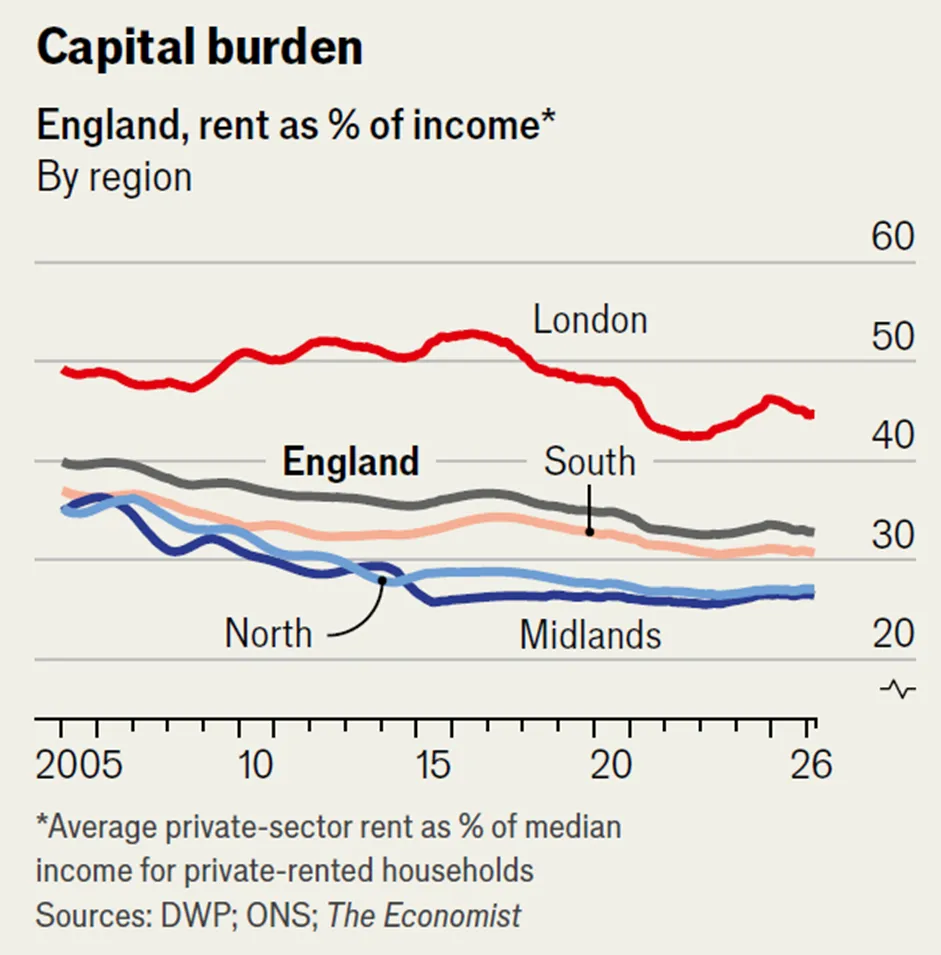
Landlords tend to get a bad rap. Yet a government-commissioned survey of private landlords found that one-third did not increase rents upon renewal in 2024, even though the market was frothy at the time. Similarly, most tenants are happy in their homes: 77% reported in 2024 that they felt “physically safe and secure”.
There are a few bad apples. Some unscrupulous landlords took to issuing no-fault eviction notices ahead of the law changing on May 1st, with the intention of turning their properties into short-term lets. Around 10% of private renters report problems with damp, compared with only 7% of people in social housing (a difference partly explained by private renters’ preference for Victorian terraces). The new act implements “Awaab’s law”, named after a two-year-old child who died from prolonged exposure to black mould in a council flat in Manchester.
For the many baby-boomers who entered the buy-to-let market in the late 1990s, the good times are over. Richard Donnell from Zoopla, a property website, says that “the numbers don’t stack up for many landlords anymore.” Four-fifths of all landlords own four or fewer homes and most purchased them to supplement pensions that they are now spending. Landlords that remain are more likely to be corporates that drive a harder bargain with tenants. As the sector stagnates, the risk is that the new law benefits incumbent tenants but makes access to renting more expensive for everyone else.
来自:The Economist
Key Takeaways

bodge job
拙劣的工作;胡乱修补;敷衍了事的工作
The repairman did a bodge job on the sink, and now it’s leaking again.
get a bad rap
受到不公正的评价;名声不好
Car salesmen often get a bad rap, but many of them are very honest.
bad apple
害群之马;坏分子
drive a harder bargain
在谈判中表现强硬;紧咬价格不放
She is a tough negotiator and always drives a hard bargain.

The numbers don’t stack up for many anymore.
对许多人来说,这笔账已经不划算了。
解读应用
The numbers don’t stack up是一个非常地道的表达,用来形容某个计划、生意或决定在逻辑上讲不通,或者在经济上不合算。当你觉得某个提议“不靠谱”或“赔本赚吆喝”时,抛出这句话显得非常专业且地道。
重点词汇替换:
The numbers → The math (数学/计算) / The deal (这桩买卖)
Don’t stack up → Doesn’t make sense (讲不通) / Isn’t viable (不可行)

The perception that rents have spiralled out of control in recent years is misplaced.
那种认为房租在近年来已失去控制的看法是不对的。
The perception that [Common Belief] is misplaced. Common Belief:大众普遍认同但可能存在偏差的观点。Misplaced:委婉且高级地表达“错误”或“不合时宜”。
将这个结构应用到“传统文化”的场景
The perception that young people no longer care about traditional culture is misplaced.

If I’m being perfectly honest,I used to think rent caps were a great idea, but now I’m not so sure.
Sure, it offers temporary relief for tenants, but if landlords feel squeezed by lower returns, they might just exit the market altogether. The thing is, we could end up with a smaller and shabbier rental sector.
Ultimately, I feel it’s less about checking boxeswith new laws and more about sustaining a healthy market where the numbers actually stack up for everyone.