需求管理、销售及运营计划、主生产排程、物料计划、能力计划、采购与供应、供应商关系管理、绩效评估、质量控制和持续改进…
CPIM规划与库存管理专业人士认证(9.0版)
Certified of Planning and Inventory Management
ASCM(APICS)国际供应链及运营管理协会权威认证课程
报名即送价值3,980的考前冲刺课!
由美国APICS 国际供应链及运营管理协会推出的CPIM规划与库存管理认证项目,是全球公认的最具权威性的供应链管理专业能力的业界最高标准。拥有该专业证书,代表你获得了世界权威机构 APICS-国际供应链及运营管理协会对于你供应链管理专业能力的认可,从而大幅提升你在职场的竞争力。
企业团队拥有CPIM 的认证,也代表该公司的团队专业能力达到世界先进水平,从而能够大大增加供应链管理的知识水平和行业的荣誉度,从而增加企业的竞争力。
CPIM 认证资格考试自1973年举办至今,全球已有约100,000名的 CPIM 人才活跃于各产业领域。他们拥有在需求管理、销售及运营计划、主生产排程、物料计划、能力计划、采购与供应、供应商关系管理、绩效评估、质量控制和持续改进等方面的基本知识、概念、专业技能以及策略意识。全球知名跨国公司与中国优秀企业如 Delphi,HP,DELL,IBM,PHILIPS,MOTOROLA,GE,ORACLE,SAP,联想,美的…等都优先聘用和晋升已取得 CPIM 认证的专业人士。
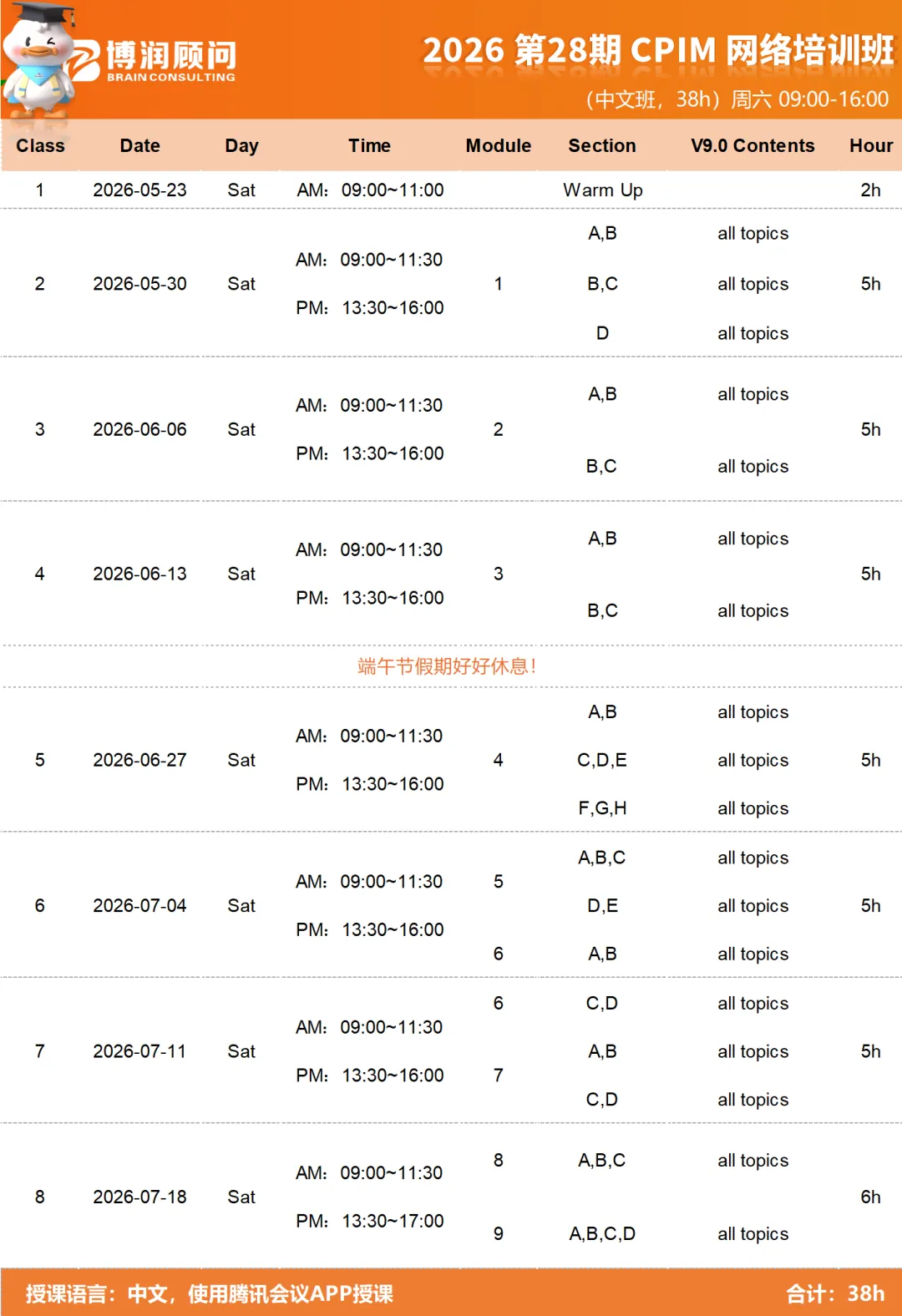
课程安排:2026
课程特色:
■课程采用APICS 英文原版教材和软件,可选择中/英文授课语言。
■由具有精湛讲课技巧,丰富实践经验,活跃在管理及咨询领域的资深专家授课。
■采用世界最具权威性和公信力的概念和术语,与全球产业的共同管理语言接轨。
■提供网上学习账号,可查询,做练习,便于备考。
■课程内容完整连贯,构建全方位的供应链管理专业知识体系。
■课程全面涵盖认证考试内容,有助于考取“CPIM 规划与库存管理”资格认证。
适合对象:
■从事制造、生产管理、物料管理、存货控制、仓储、物流、采购、工业工程、销售、供应链管理、品质管理、客户服务等相关领域的专业人士;
■从事ERP、SCM 相关的咨询顾问及软件设计开发和推广的工程师;
■制造或物流企业的中高级部门主管;
■有兴趣取得国际性专业认证,成为国际化专业人才的有志之士。
课程目标:
■个人收获:CPIM通过提供给学员有效的评估和管理业务活动的工具,从而帮助学生增加规划与库存管理的专业知识和职业能力。
■公司收获:员工可通过CPIM项目学习到如何在组织全球运营范围内评估规划和库存业务活动的相关知识与技能,其包括:提升效率,技术投资回报率最大化,流程优化等,来应对机遇和挑战。
课程结构:
CPIM 认证课程包括9部分的内容
■Module 1: Supply Chains and Strategy 供应链与战略
■Module 2: Sales and Operations Planning 销售与运营规划
■Module 3: Demand需求
■Module 4: Internal Supply内部供应
■Module 5: External Supply and Key Support Functions 外部供应与关键支持功能
■Module 6: Inventory 库存
■Module 7: Detailed Schedules 详细排程
■Module 8: Distribution 分销
■Module 9: Quality, Business Investments, and Continuous Improvement 质量、商业投资与持续改进
详细课程介绍详见文末附件
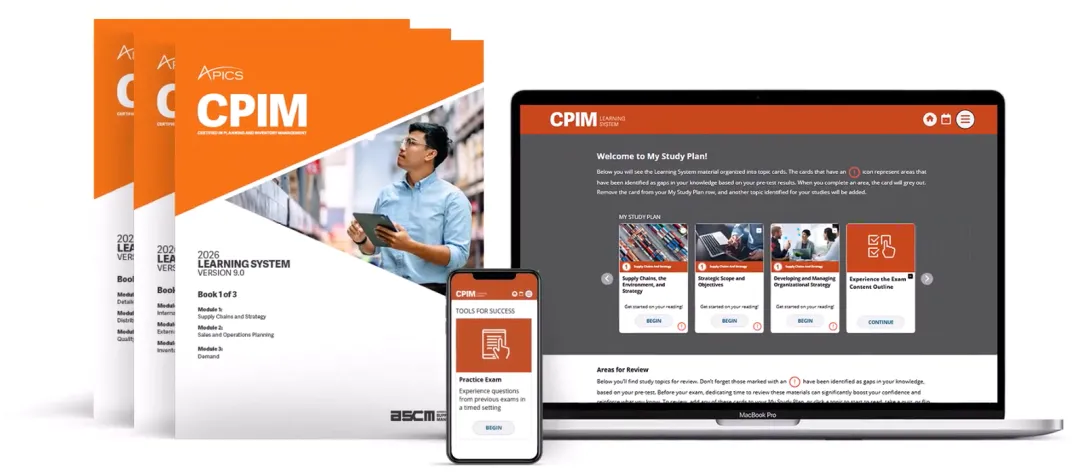
版权教材:
资料构成:
课程使用的CPIM学习系统包括:
■教材课本分为三本英文原版教材和一本讲义。
■一个APICS在线学习账号,网上辅助学习系统CPIM learning system including
■可以方便使用移动设备学习
■每个模块有相应的学习活动
■可提供详尽的个人进度报告
培训师资:
由具有精湛讲课技巧,丰富实践经验,全球认证的资深专家授课
■采用世界最具权威性和公信力的概念和术语,与全球产业管理的共同语言接轨
■小班授课, 更多讨论和案例研究
■课程内容知识完整连贯
■课程内容覆盖认证考试内容,有助于通过CPIM规划与库存管理专业资格认证
考试安排:
■ 考试为英文计算机考试
■ 包括150道单选题(其中20题为测试题),时长三个半小时。
■350分为满分,300分为通过
再认证:
再认证为五年,需要累积75个再教育学分
培训费用:
线下培训CPIM Bundle(一次免费重考机会)
APICS Plus Member(高级会员年费) 1,600元/人
考试卷&学习系统 (Bundle 会员价) 16,600元/人
CPIM课程培训费(线下培训班) 9,980元/人
总计费用:28,180元/人
网络培训CPIM Bundle(一次免费重考机会)
APICS Plus Member(高级会员年费) 1,600元/人
考试卷&学习系统 (Bundle 会员价) 16,600元/人
CPIM课程培训费(网络培训班) 7,960元/人
总计费用:26,160元/人
课程大纲:(中英)
Module 1: Supply Chains and Strategy
■Section A: Supply Chains, the Environment, and Strategy
Supply Chain and MPC Overviews
Strategy Overview
Mission, Vision, and Values
■Section B: Environment Analysis and Strategic Scope
Analyzing the External Environment
Analyzing the Internal Environment
Strategic Scope
■Section C: Developing and Managing Strategy at Various Levels
Order Qualifiers and Winners
Generic Strategies
Functional and Operational Strategies
Aligning Facility Strategy
Executing, Monitoring, and Changing Strategy
■Section D: Performance Monitoring and KPIs
Performance Monitoring Systems
Strategic, Financial, and Operational Metrics
Module 2: Sales and Operations Planning
■Section A: S&OP Purpose and Process
S&OP Overview and Key Linkages
S&OP Roles and Process
Integrating and Balancing Roles of S&OP
■Section B: Aggregate Demand and Supply
Aggregate Demand and Supply Plans
Production Planning Grid and Production Methods
Resource Planning for Capacity and Marketing Strategies
Resource Planning as Capacity Check, HR, and Strategic Buffers
■Section C: Reconciling S&OP Plans
Synchronizing Supply and Demand
Tradeoffs, Alternatives, and Approved Plan
Module 3: Demand
■Section A: Demand Management
Demand Management Overview
Customer Segments and Strategic Objectives
Customer Relationship Management
Customer Service Methods
Customer Metrics
InfluencingDemand and Product Designs
■Section B: Sources of Demand/Forecasting
Demand Channels and Sources
Forecasting Overview and Selection
Qualitative Forecasting
Quantitative Forecasting
■Section C: Forecast Performance
Evaluating Forecast Performance
Forecast Management
Index
Contents
Module 4: Internal Supply
■Section A: Functional and Operational Strategies
Analysis for Functional and Operational Strategies
■Section B: Environments, Types, and Layouts
Push-Pull Strategy and Manufacturing Environment
Product-Process Matrix
Determining Process Type and Layout
Service Design and Project Management for ETO or Improvements
■Section C: Creating the Master Schedule
Master Scheduling Overview
Product Structure Impact on Master Scheduling
Creating the MPS
■Section D: Rough-Cut Capacity Planning and MPS Validation
Rough-Cut Capacity Planning
Master Production Schedule Validation
■Section E: Using and Maintaining the Master Schedule
Using the Master Schedule
Maintaining the Master Schedule
■Section F: Material Requirements Planning
MRP Overview and Design
MRP Inputs, Process, and Outputs
Using and Managing MRP
■Section G: Capacity Requirements Planning, Order Promising, and Final Assembly Scheduling
Capacity Requirements Planning
Available-to-Promise, Capable-to-Promise, and Order Promising
Final Assembly Scheduling
■Section H: Changes and Supply Disruptions
Supply Disruptions Overview
Replanning and Revision
Module 5: External Supply and Key Support Functions
■Section A: Suppliers and Procurement
Supply and Purchasing Planning
Supplier Relationships and Strategies
Capable Suppliers and Contracts
■Section B: Purchasing and Maintenance
Purchasing Cycle and Contract Buying
Supplier Performance
■Section C: Risk Management
Risk Management Process
Identifying, Assessing, and Managing Risks
■Section D: Sustainability Strategies
Sustainability Overview
Sustainability Strategy and Standards
Impact, Mitigation, Metrics, and Reporting
■Section E: Waste Hierarchy and Reverse Logistics
Waste Hierarchy
Reverse Logistics and Product Disposition
Module 6: Inventory
■Section A: Inventory Planning
Purposes and Goals of Inventory
Inventory Types and Classifications
Inventory Policy
■Section B: Inventory Costs, Basic Accounting, Costing, and Metrics
Inventory Costs Overview
Accounting and Costing
Variance Analysis
Financial Performance Measures and Inventory Finance
■Section C: Inventory Management
Push or Pull Replenishment
Economic Order Quantity and Lot-Size Rules
Safety Stock and Safety Lead Time
Special Inventory and MRO Supplies
■Section D: Inventory Control
Inventory Storage, Flow, and Handling
Inventory Accuracy
Index
Contents
Module 7: Detailed Schedules
■Section A: Planning Detailed Schedules
Detailed Scheduling and Throughput
Production Activity Control
■Section B: Scheduling and PAC Methods
Intermittent/Flow Manufacturing, Scheduling, and PAC
MRP-Based Scheduling and PAC
Lean Environments, Scheduling, and PAC
TOC Scheduling and PAC
Nonstandard Demand
■Section C: Creating Production and Service Schedules
Capacity Planning and Service Capacity
Capacity Requirements Planning (CRP)
■Section D: Managing Detailed Schedules and Scheduling Materials
Labor/Production Scheduling and Managing HR
Execution and Capacity Performance
Module 8: Distribution
■Section A: Planning Distribution
Distribution and Inventory Planning
Network Configuration
Design or Redesign a Logistics Network
Evaluate Network and Transportation Requirements
Evaluate Facility Requirements
Make Facility Number and Type Decisions
Understand Different Network Modeling Approaches
Distribution Plans
■Section B: Replenishment
Replenishment Planning
Distribution Requirements Planning
■Section C: Order Management, Trace/Track, and KPIs
Customer Order Management
Inventory Traceability and Tracking
Distribution Performance KPIs
Module 9: Quality, Business Investments, and Continuous Improvement
■Section A: Quality
Quality Planning and Assurance/Control
Measuring Quality Costs
Quality Tools
■Section B: Capital Equipment and Facilities
Business Planning and Capital Budgeting
Total Productive Maintenance and Health, Safety, and Environment
■Section C: Technology
Requirements, Gap Analysis, and Selection
Implementing and Maintaining Technologies
Technologies
■Section D: Continuous Improvement
Continuous Improvement Strategies
Lean
Employee Empowerment
Relationship Improvement Tools
Structured Problem-Solving Tools
Additional Process Improvement Tools
Work Area Design
Process Variation
Course Bibliography
Index
模块1:供应链与战略
■A部分:供应链、环境与战略
供应链与MPC概览
战略概述
使命、愿景和价值观
■B部分:环境分析与战略范围
分析外部环境
分析内部环境
战略范围
■C部分:各级别战略的制定与管理
订单资格确认与获得
通用策略
功能和运营策略
设施战略调整
执行、监控和调整战略
■D部分:绩效监控与关键绩效指标(KPIs)
性能监控系统
战略、财务和运营指标
模块2:销售与运营规划
■A部分:S&OP的目的与流程
S&OP概述及关键关联
S&OP的角色与流程
整合与平衡S&OP的角色
■B部分:总需求与总供给
总需求与总供给计划
生产计划网格和生产方法
产能资源规划与营销策略
资源规划作为能力核查、人力资源和战略缓冲
■C部分:协调S&OP计划
供需同步
权衡、备选方案和获批计划
模块3:需求
■A部分:需求管理
需求管理概述
客户细分与战略目标
客户关系管理
客户服务方法
客户指标
影响需求与产品设计
■B部分:需求来源/预测
需求渠道与来源
预测概述与选择
定性预测
定量预测
■C部分:预测性能
评估预测性能
预测管理
索引
目录
模块4:内部供应
■A部分:功能和运营策略
功能与运营策略分析
■B部分:环境、类型和布局
推拉策略与制造环境
产品-流程矩阵
确定工艺类型和布局
面向ETO的服务设计与项目管理或改进
■C部分:制定主进度表
主调度概览
产品结构对主生产计划的影响
创建主生产计划(MPS)
■D部分:粗略能力计划与主生产计划(MPS)验证
粗略产能规划
主生产计划验证
■E部分:使用和维护主进度表
使用主进度表
维护主进度表
■F部分:物料需求计划
MRP概述与设计
MRP的输入、流程和输出
使用和管理物料需求计划(MRP)
■G部分:产能需求规划、订单承诺和总装调度
产能需求规划
可供承诺量、可承诺能力、订单承诺
最终装配调度
■H部分:变更与供应中断
供应中断概览
重新规划和修订
模块5:外部供应与关键支持功能
■A部分:供应商与采购
供应与采购规划
供应商关系与策略
有能力的供应商和合同
■B部分:采购与维护
采购周期与合同采购
供应商绩效
■C部分:风险管理
风险管理流程
识别、评估和管理风险
■D部分:可持续性策略
可持续性概述
可持续性战略与标准
影响、缓解措施、指标和报告
■E部分:废物层级和逆向物流
废物层级
逆向物流与产品处置
模块6:库存
■A部分:库存计划
库存的目的和目标
库存类型与分类
库存政策
■B部分:库存成本、基础会计、成本核算和指标
库存成本概览
会计与成本核算
方差分析
财务绩效衡量与存货融资
■C部分:库存管理
推式补货或拉式补货
经济订货批量与批量规则
安全库存和安全提前期
特殊库存及MRO用品
■D部分:库存控制
库存存储、流转与处理
库存准确性
索引
模块7:详细排程
■A部分:规划详细日程
详细排程与吞吐量
生产活动控制
■B部分:调度和PAC方法
间歇/流程制造、调度和PAC
基于MRP的调度和PAC
精益环境、调度和PAC
TOC调度和PAC
非标准需求
■C部分:制定生产和服务计划
容量规划与服务能力
产能需求规划(CRP)
■D部分:管理详细日程和安排材料
劳动/生产调度与人力资源管理
执行与容量性能
模块8:分销
■A部分:规划分布
分销与库存规划
网络配置
设计或重新设计物流网络
评估网络和运输需求
评估设施需求
确定设施编号和类型
了解不同的网络建模方法
分销计划
■B部分:补货
补货计划
分销需求规划
■C部分:订单管理、追踪/跟踪和关键绩效指标(KPI)
客户订单管理
库存可追溯性与跟踪
分销绩效关键绩效指标
模块9:质量、商业投资与持续改进
■A部分:质量
质量规划与保证/控制
衡量质量成本
质量工具
■B部分:资本设备和设施
业务规划与资本预算
全面生产维护与健康、安全和环境
■C部分:技术
需求、差距分析及选择
实施和维护技术
技术
■D部分:持续改进
持续改进策略
精益
员工赋能
关系改善工具
结构化问题解决工具
其他流程改进工具
工作区设计
工艺变异
课程参考书目
索引