科技行业就业市场崩盘是真实存在的.(现在)别把责任都推给人工智能

Why technology firms are shedding workers
为什么科技公司要裁员
4月 15, 2026 01:19 上午 | San Francisco

listening
1
AMERICAN TECH is in lay-off mode. Oracle, a wannabe cloud-computing hyperscaler, recently announced thousands of job cuts. Block, a digital-payments darling, is slashing more than 4,000 roles—nearly half its workforce. Amazon and Meta have announced redundancies. From 2022 to 2025 these two and the other five giants in tech’s “magnificent seven” scarcely grew their payrolls. Total employment, technology-related and otherwise, in San Francisco, the world’s tech capital, has fallen by 3% since the beginning of 2023.
美国科技行业正处于裁员浪潮之中。立志成为云计算超大规模企业的甲骨文公司(Oracle)近期宣布裁员数千人。数字支付领域的宠儿Block公司也正在裁减4000多个职位,几乎占其员工总数的一半。亚马逊和Meta公司也宣布了裁员计划。从2022年到2025年,这三家公司以及科技界“七巨头”中的其他五家公司几乎没有增加员工人数。自2023年初以来,作为世界科技之都的旧金山,包括科技相关行业在内的总就业人数下降了3%。
2
This is not, as bosses tell it, because the tech industry is in a funk. On the contrary, it is because the sector is in the midst of a generational boom, courtesy of artificial intelligence. Boosters argue that AI is getting extremely good extremely fast at the sort of work many tech employees perform—spookily so, as the latest model from Anthropic, a leading lab, shows. Humans, in short, are becoming redundant.
这并非像老板们所说的那样,是因为科技行业正处于低迷期。恰恰相反,这是因为人工智能正推动着该行业迎来一代人的繁荣。支持者认为,人工智能在许多科技从业人员所从事的工作中正以惊人的速度变得极其出色——领先实验室Anthropic的最新模型就证明了这一点。简而言之,人类正在变得多余。
3
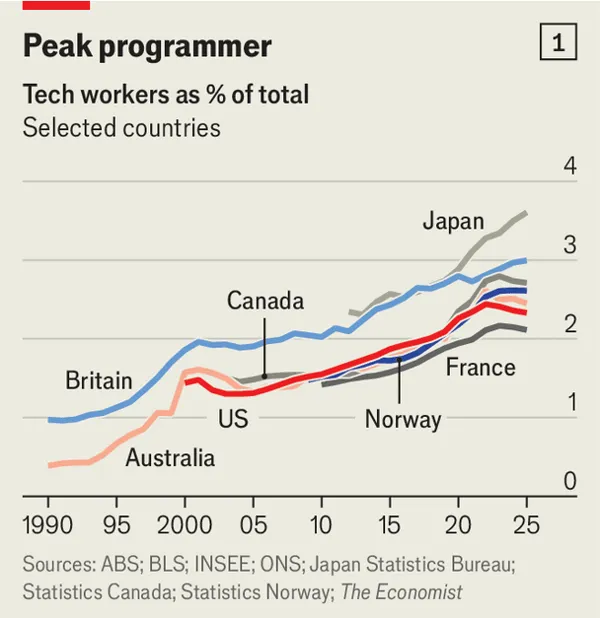
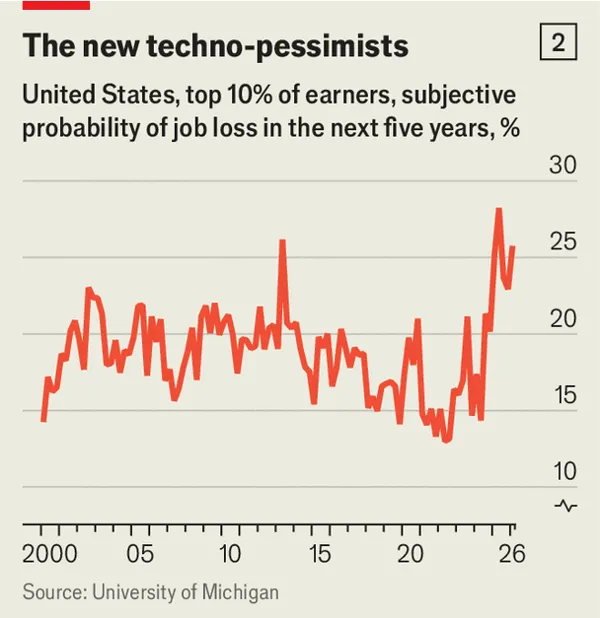
Worries about a tech-jobs AI-mageddon spread far beyond Silicon Valley. Across America, technology’s share of overall employment has dipped from a peak of 2.5% in late 2022 to 2.3% today (see chart 1). More than 500,000 tech jobs are now “missing”, relative to what you might have expected from earlier trends. Employment in some sub-industries has fallen sharply; “web-search portals and all other information services” employ 7% fewer people than in December 2022. High-earners, many of whom work in tech, think that more disruption could be on the way. The top 10% have never been more worried about losing their jobs (see chart 2).
对人工智能可能引发科技行业就业危机的担忧已远远超出硅谷。在美国,科技行业在整体就业中所占的份额已从2022年底的峰值2.5%下降到如今的2.3%(见图表1)。与此前的趋势相比,目前科技行业的就业岗位减少了超过50万个。一些细分行业的就业人数急剧下降;“网络搜索门户和其他所有信息服务”的就业人数比2022年12月减少了7%。许多在科技行业工作的高收入人群认为,未来可能还会出现更大的变革。收入最高的10%人群从未像现在这样担心失业(见图表2)。
4
The bust in tech jobs is not just an American phenomenon. We have gathered comparable data on tech employment across seven large economies: America, Australia, Britain, Canada, France, Japan and Norway. This includes companies in software development, computer programming and cloud computing. Our analysis points to a remarkably consistent trend. Tech employment rose sharply in the years before 2022. In November of that year OpenAI released ChatGPT to the public, ushering in the AI age. Since then, tech’s share of overall employment has stagnated or fallen. Surely that is not a coincidence?
科技行业就业岗位的下滑并非美国独有的现象。我们收集了七个主要经济体(美国、澳大利亚、英国、加拿大、法国、日本和挪威)的科技就业数据,涵盖了软件开发、计算机编程和云计算等领域。我们的分析揭示了一个惊人的一致趋势:在2022年之前,科技行业的就业人数曾大幅增长。同年11月,OpenAI发布了ChatGPT,开启了人工智能时代。此后,科技行业在整体就业中所占的份额停滞不前甚至有所下降。这难道仅仅是巧合吗?
5
It may be. For economists examining AI’s impact on the labour market, ChatGPT’s launch is a convenient starting-point. But it is also misleading. Those early AI tools were primitive. Only since the release in February 2025 of Claude Code, an AI programming assistant devised by Anthropic, has it become remotely plausible for an AI tool to replace a human software engineer. Until the past few months, when Claude Code has spread like a Californian wildfire across technology firms, any slowdown in tech recruitment is unlikely to have had much to do with AI.
或许如此。对于研究人工智能对劳动力市场影响的经济学家来说,ChatGPT 的发布是一个便捷的切入点。但这同时也具有误导性。早期的那些人工智能工具还很原始。直到 2025 年 2 月,由 Anthropic 公司开发的 AI 编程助手 Claude Code 发布之后,人工智能工具取代人类软件工程师才变得勉强可行。在过去几个月里,Claude Code 像加州野火一样迅速蔓延到各大科技公司之前,科技行业招聘放缓不太可能与人工智能有太大关系。
6
AI enthusiasts excited about such tools also overrate their popularity—and, by extension, their macroeconomic effects. America’s Census Bureau estimates that just 28% of firms in the San Francisco metropolitan area use AI regularly as part of their day-to-day operations. In America as a whole, adoption is much lower. And usage does not necessarily mean job displacement. A recent survey of firms across America, Australia, Britain and Germany by Ivan Yotzov of the Bank of England and colleagues finds that over the past three years AI has had “essentially zero” impact on employment.
人工智能爱好者对这类工具的热情往往过高,他们高估了人工智能的普及程度,进而高估了其宏观经济影响。美国人口普查局估计,旧金山都市区只有28%的企业将人工智能作为日常运营的一部分。而全美范围内的普及率则更低。而且,使用人工智能并不一定意味着会造成就业岗位流失。英国央行的伊万·约佐夫及其同事近期对美国、澳大利亚、英国和德国的企业进行的一项调查发现,过去三年人工智能对就业的影响“几乎为零”。
7
History is another reason for pause. You might think that as economies become more tech-intensive over time, technology’s rising share in total employment is an iron law of nature. Yet for most of the 2000s that share in America, Australia, Britain and Canada hardly budged. As late as 2006-07, as the rich world was busily inflating a gargantuan financial bubble, tech employment was soft. AI clearly was not to blame.
历史是另一个值得我们深思的原因。你或许会认为,随着经济体逐渐变得技术密集,技术在总就业中所占比例的上升是必然的。然而,在2000年代的大部分时间里,美国、澳大利亚、英国和加拿大的这一比例几乎没有变化。直到2006-2007年,当发达国家忙于吹起巨大的金融泡沫时,科技行业的就业形势依然疲软。显然,人工智能并非罪魁祸首。
8
Back then it was the earlier bursting of the dotcom bubble in 2000 which held down job growth in the industry. After the spectacular pop many tech companies gradually ran out of money and were forced to close. But by the middle of the decade analysts began arguing that other factors were at play, too. To save money, firms were increasingly outsourcing tasks to foreign IT consultancies like India’s TCS and Infosys. Another factor was monetary policy. American interest rates began rising in late 2004. Higher borrowing costs discouraged businesses from investing in software and computer equipment—in turn trimming demand for people who installed and managed it.
当时,2000 年互联网泡沫的破裂抑制了该行业的就业增长。泡沫破裂后,许多科技公司资金逐渐耗尽,被迫倒闭。但到了 20 世纪 50 年代中期,分析师开始指出,还有其他因素在起作用。为了节省成本,企业越来越多地将任务外包给像印度塔塔咨询服务公司 (TCS) 和印孚瑟斯 (Infosys) 这样的外国 IT 咨询公司。另一个因素是货币政策。美国利率在 2004 年底开始上升。更高的借贷成本抑制了企业对软件和计算机设备的投资,进而减少了对安装和管理人员的需求。
9
Tech workers’ current predicament looks eerily similar. Many firms went on a hiring binge amid the covid-19 pandemic, as locked-down consumers’ demand for all things digital ballooned. In 2022 interest rates started rising fast as central banks realised that pandemic-related inflation was not a seasonal cold but something more chronic; in 2023 growth in business investment in IT slowed sharply. Looking to save costs, firms once again turned to outsourcing. From 2021 to 2024 (the latest available data) American imports of services related to cloud computing and data storage more than doubled. Why employ someone on a Bay Area salary if you can get the same service from Bangalore for a quarter of the cost?
科技工作者目前的困境与此惊人地相似。在新冠疫情期间,许多公司疯狂招聘,因为居家隔离的消费者对各种数字化产品的需求激增。2022年,随着各国央行意识到疫情引发的通胀并非季节性疾病,而是更为长期的顽疾,利率开始快速攀升;2023年,企业在IT领域的投资增长急剧放缓。为了节省成本,企业再次转向外包。从2021年到2024年(最新可用数据),美国云计算和数据存储相关服务的进口额翻了一番还多。既然能在班加罗尔以四分之一的成本获得同样的服务,为什么还要雇佣湾区高薪的员工呢?
10
A subtler phenomenon is also at play. Though many Silicon Valley businesses have frozen hiring, firms in other industries are more than happy to snap up workers with tech skills. Our analysis of American occupational data—looking at people who describe themselves as “software developers” and so on—suggests strong demand for tech workers. Today 3.7% of people have tech-related occupations, up from 3.6% in November 2022. A new paper by Leland Crane and Paul Soto of the Federal Reserve suggests that companies are expanding their ranks of coders more slowly than before the introduction of ChatGPT—but continue to expand them nonetheless.
还有一个更为微妙的现象正在发挥作用。尽管许多硅谷企业已经冻结招聘,但其他行业的公司却非常乐意招揽拥有技术技能的人才。我们对美国职业数据的分析——主要针对那些自称“软件开发人员”等职业的人群——表明,市场对技术人才的需求十分强劲。如今,3.7% 的人从事与技术相关的工作,高于 2022 年 11 月的 3.6%。美联储的 Leland Crane 和 Paul Soto 的一篇新论文指出,尽管 ChatGPT 出现后,企业扩充程序员队伍的速度有所放缓,但扩充规模的步伐仍在继续。
11
The unsexy, non-AI economy—retailers, banks, hospitals, manufacturers and other businesses that still account for the bulk of rich-world employment—are also hoping that AI could allow a single nerd to get more done. But given that many such companies employ few nerds right now, that still means plenty of demand for tech skills. From 2022 to 2025 the number of computer and software workers employed in America’s retail sector grew by 12%. It grew by 75% in real estate and by nearly 100% in construction.
那些并不热门、非人工智能领域的经济部门——零售商、银行、医院、制造商以及其他仍然占据发达国家就业主体的企业——也希望人工智能能够让一个技术宅完成更多的工作。但鉴于目前许多这类公司雇佣的技术宅数量很少,这意味着对技术技能的需求依然旺盛。从2022年到2025年,美国零售业的计算机和软件从业人员数量增长了12%,房地产行业增长了75%,建筑业增长了近100%。
12
Even as the AI threat looms, in other words, tech jobs are not going away. They are instead spreading through the whole economy. In the old days the route to riches ran through a job at Google or Meta. Today, an ambitious young programmer might consider applying to Starbucks—and not as a barista. ■
换句话说,即便人工智能的威胁迫在眉睫,科技工作也不会消失。相反,它们正在向整个经济领域扩散。过去,通往财富的道路是在谷歌或Meta这样的公司找到一份工作。而如今,一位雄心勃勃的年轻程序员可能会考虑去星巴克应聘——但不是去当咖啡师。■
结语

To share with friends